Sunday, March 27, 2016

Rock & Roll revisited (Game Design Attack #4)

I played Rock & Roll at Game Design Attack #4 this weekend, and Tim had a really neat idea of a slightly different sort of structure, making it a bit more like a standard Yahtzee-style press your luck game. I thought of a related way to make sure there was some interaction so the game didn't feel solitary, and after a prototype update I was able to try the new version a couple of times and I think it might be a step in the right direction. The new version is highly thematic as well -- now there are song cards, so instead of scoring individual crowd tokens for as many points as possible, you play a song in order to please as many crowd members as possible. The songs have specific die results in a specific order.

Three of these songs are dealt out in a supply, and you start your turn by rolling 6 dice bearing symbols for Vocals, Drums, Guitar, Bass, Solo, and Gaffe. Gaffes are mistakes, and you are forced to lock those in when they come up. After rolling, you must lock in at least 1 symbol required for the song, and those symbols must be done in order from left to right as you play through the song. At this point if you fail to lock in a symbol required by the song, you must end your turn, and you get a small scoring penalty. However, as long as you did lock in a symbol, you can choose to stop and score, or roll any number of the unlocked dice trying to get the next required symbol.

Of course, you can also use cards to help you. You will start with just 1 card, but you can get more: at the end of your turn, you'll draw a new card for every 2 Gaffes you had. Also, if you are able to complete the entire song, you'll collect a completion bonus, which may be extra points, or perhaps a card.

As long as you don't fail, then you score some points based on the number of dice you were able to lock in, and you take the song and place it in front of you. Any player may either choose to play a new song from the center, or attempt to outperform you on your song. In order to do so, they must lock in more dice than you were able to, and if you were able to complete the song then they must also lock in 1 additional Solo -- if they are to outperform you then they must perform the song with more gusto and flair than you did! At the beginning of your next turn, if nobody has outperformed you on your song, then you place it into your "set list" and save it for potential end game bonus scoring.

A suggestion was made to add something -- I'd call them Record Labels perhaps -- which could act like the nobles in Splendor: an in-game scoring opportunity based on the genres of songs in your set list.

When the supply of crowd tokens (VPs) is exhausted and all players have had an equal number of turns, the game ends and there will be some set collection scoring based on genres of songs in your set list.

I'm excited about this new version, and I hope to play it with a few more groups to see how it goes over.

Game Design Attack #4 -- brief recap

Over the last few years, I've hosted a game design retreat here in Tucson which I call Game Design Attack:


This year Tim Fowers and Ryan Lauket came down from Utah, and Rob came in from California again. Gil Hova and J.R. Honeycutt had to cancel, but maybe next year they'll be able to join us. Dan Keltner and David Short are locals and they stopped in for a bit as well.

The guys showed up Thursday evening, and we started out the design talk by taking turns basically describing one of the games we'd brought to work on, and discussing it. Right out of the gate there was some great discussion -- even before the games were on the table!

Over the course of the weekend, each of us got at least one game to the table

Ryan brought two upcoming Red Raven titles (or potential titles, I'm not actually sure what the full story is on them).

The first one which I saw a few weeks ago at SaltCon, a euro style game with storytelling elements that's a follow up to Above and Below. I liked it a lot, though the scoring tended to snowball a bit. After Friday night's play, Ryan made a significant change and it then on Saturday we tried it again and it was much better. I think with a few more tweaks that game will be ready for prime time!

The second game Ryan brought was a co-design with Alf Seegert called Haven. We had some suggestions about that one, and tried implementing some of them... I think that one needs a bit more work, but could become a nice light 2p game.

Rob had come up with an idea for a game, and spent some of this weekend putting together a prototype and we gave it a try. The game was about crafting weapons for knights to use in a tournament, and it involved drafting sets of cards (some known and some unknown), refining your set, and finally resolving fights with a knight and your set of cards.

Originally there was an auction for the lots of cards, as well as a low-bid auction for the knights, and much of the action was fiddly and awkward -- not surprising for a first draft! But we made some adjustments on the fly which made things better. After the game we discussed a few potential improvements such as removing gold and auctions, and instead just drafting piles of cards, and later we played again with some modifications and the whole thing worked much better.

This was definitely a game where the designer's vision did not match up with how I would have done it, so when I got home I put together a similar prototype that I might try my version of Rob's game.

Tim's latest project is Fugitive, a 2 player deduction game where one player is a fugitive on the run, and the other is a U.S. Marshall trying to catch him. I played the game at SaltCon a few weeks ago, and he's made some improvements since then. At SaltCon it seemed like the Marshall couldn't won, but now it seemed like they coudn't lose... so Tim made another tweak to try and get the balance right, and the next few games were won by some mix of fugitive and marshall - so I think it's almost there.

Tim also has a new version of Now Boarding, the game he and I came up with, prototyped, tested, and updated at Game Design Attack #1 back in 2013. The new version is quite different than the original, but has some key aspects in common of course. It's still a real time cooperative game, and the new version addresses feedback from players of the previous version that it didn't feel cooperative enough.

Tim had a 3rd game with him, one that I think he's got on his back burner. Flowchart Fighter is a 2 player fighting game, like a Street Fighter card game so to speak.

David wasn't there very long, but he was able to get his micro deckbuilder, Another Man's Treasure, to the table. It has some interesting ideas in it, but David seems to be struggling to get it to work the way he wants it to.

Dan had a new version of his puzzle game, and a new single deck card game inspired by my comments about the book track in Mombasa. I didn't play the former, but I liked the latter quite a bit. We ran out of cards, so apparently more are needed, and I thought maybe another suite of resource types might help as well, but it certainly seems like a good start.

I was able to get 2 different games to the table this weekend. Rock & Roll is a light dice rolling / resource management type of game which was intended to be a sort of follow up to Dungeon Roll -- not related to that game, but to appeal to the same type of player perhaps. I've gone through a few iterations on that game, and got it to a point where it technically worked, but I had trouble knowing whether it was good enough or fun enough for the target audience since I'm not really in the target audience.

Tim had a really neat idea of a slightly different sort of structure, making it a bit more like a standard Yahtzee-style press your luck game. I thought of a related way to make sure there was some interaction so the game didn't feel solitary, and after a prototype update I was able to try the new version a couple of times and I think it might be a step in the right direction. The new version is highly thematic as well -- now there are song cards, so instead of scoring individual crowd tokens for as many points as possible, you play a song in order to please as many crowd members as possible. I'll go into more detail about this new version in a separate post.

Finally, I also got Deities& Demigods to the table. This game has worked in a general sense so far, but I've had problems with a lack of interaction, some hesitation about combat rules, and game length. I haven't thought about this game much since last November, but after re-familiarizing myself with it and playing a game, I got to formalize the issues and get some feedback on how to address them. I had been thinking that the board needed to be smaller, but I didn't know how to reduce the size while still having enough cities and quest locations. I got some good suggestions to address those problems which I'll elaborate on in a separate post. I stayed up until 3am updating my prototype, but sadly was unable to get it back to the table this weekend, so I'm antsy to get another playtest in soon!

All in all I think it was a highly successful and very fun weekend!

Saturday, March 19, 2016

Oblivion playtest -- with the new planets and techs and stuff! Big update with lots of details!

I played a 4p game of Eminent Domain: Oblivion today. If you've only just happened upon this blog, or if you've been living under a rock or something, Oblivion is the 3rd expansion to my card game Eminent Domain. The first expansion, Escalation, has been out for just over a year, and the second one, Exotica, is going to hit store shelves in about 2 weeks. Oblivion will likely be the final expansion for the game.

I've posted quite a bit about this expansion over the several years I've been working on it, so I'll assume you have read that, or will go read it if you haven't and are interested (go ahead, I'll wait...)

Yesterday I finally got around to making more planets for the expansion, and while I'd discussed not including any tech in this set (I feel like there's kind of already too many techs, and too many points in the tech stacks), there are some fairly obvious types of effects that would make sense to have. So I decided to make a couple of Diverse techs (requiring Metallic, Fertile, and Advanced planets), and more importantly a small stack of Prestige tech. This is because I also decided to make most of the new planets Prestige types, the idea being that Prestige planets are all about the politics.

Originally I'd made 5 planets... 1 each of metallic, advanced, and fertile with a Politics icon, and 2 Prestige planets with a replenishing Clout token. I had talked about making more planets of the Bustling variety (ones that give you actions -- there were a handful of those in Escalation), and I decided to make them all Prestige planets. Since I make prototypes on 8.5x11 sheets of paper and can fit 9 cards on a sheet, I made 9 new planets... which seemed like a good number actually, since there are 9 of each planet type in the base game. So in Oblivion, if I remove one of the replenishing clout planets, there'll be 10 of each planet type total. That means there'll be enough to go around that I can make a Prestige tech stack without worrying too much about people not being able to access it. In fact, I should probably make that stack more robust, but if I don't make prestige starting planets then it's not as big a deal.

PLANETS

Anyway, I made the following planets:
Advanced -- Politics icon, Silicon (3vp)
Fertile -- Politics icon, Food, Water (2vp)
Metallic -- Politics icon , Iron (3vp)
Prestige -- Replenishing Clout (2vp)
Prestige -- Action: Draw 2 Clout tokens (2vp)
Prestige -- Action: Recon the Agenda deck (4vp)
Prestige -- Action: Recon your deck (2vp)
Prestige -- Action: Swap 2 upcoming or Active Agendas (3vp)
Prestige -- Action: Dismiss up to 2 Upcoming Agendas (4vp)
Prestige -- Action: Discard a Clout token to collect 1vp (2vp)
Prestige -- Action: Annex a Planet (pay [POL] equal to its Annex cost) (3vp)
Prestige -- Action: Trade 1 Resource for 1vp and a Clout token (2vp)
Prestige -- Your planets gain Annex Cost: 6[POL] (3vp)

Having now played with these planets, I think some of them might need tweaks. The two 4vp planets' actions are pretty weak or narrow, but that's why I made them 4vp. I could potentially add resource slots to some of them, but historically, Prestige planet resource slots can hold "any resource", and that might interact too strongly with some of the Agendas (then again, maybe that's a good thing).

ANNEXING PLANETS

I mentioned an Annex cost in the previous section. All of the new Prestige planets have an Annex cost listed on them (they're all Annex Cost: 4[POL]). There are a few effects which give you ACTION: Annex a planet (pay [POL] equal to its Annex cost). In addition, as an option when doing a Politics role, instead of activating or dismissing an Agenda, you may Annex a planet (which of course means flip it over by paying it's annex cost).

John suggested that the Politics cards could have "ACTION: Annex a planet" on them, but for one thing, the Politics cards already have an action printed on them, and for another I wouldn't want to have to reprint all the politics cards! Also, it might be too easy to flip the Prestige planets that way.

The Improved Political Influence tile (hmm, maybe I should just call that the "Politics tile" -- "Political Influence is a very long term!) now has All planets gain Annex Cost: 7[POL] instead of the extra vp for trading at least 3 different resources at a time.

I'm not sure those costs are perfect, they may need some tweaking. I settled on 7 for the Politics tile because Improved Politics also gives you a Politics icon, so you really only need 6 other ones, and that's on par with one of the more expensive Agenda costs (and so shouldn't be impossible). It might be too high though, and I could see bringing that down to 6. 5 seems awfully low, though it's still higher than the standard Annex cost of 4 printed on the Prestige planets.

TECHNOLOGY

As I mentioned, I made just a couple of Diverse tech cards:
Diverse Lobbyist (Diverse perm L1): [POL] (a permanent politics icon)
Diverse Clout (Diverse perm L1): Whenever you draw Clout tokens, draw 1 more and then discard a Clout token.

Filibuster (Diverse perm L1): When dissenting a role, draw 1 clout token.
Party Whip (Diverse perm L1): When another player follows your role, draw 1 clout token.

And I made one of each Advanced, Fertile, and Metallic tech:
Farming Subsidy (Fertile perm L1): ACTION: Discard any number of Clout tokens. produce 2 resource for each clout discarded this way.
Grassroots Movement (Fertile perm L1): Your [COL] icons can be used as [POL].

Free Trade Agreement (Advanced perm L1): Once per turn: You may discard a Clout token to collect 1vp.
Scientific Community (Advanced perm L1): Your [RES] icons can be used as [POL].

Political Climate (Metallic perm L1): ACTION: Recon the Planet deck for a Prestige planet.
Police State (Metallic perm L1): You may attack planets by paying [F] equal to the Annex cost.

And of course, a handful of Prestige tech:
Political Annexation (Prestige L1):ACTION: Annex a planet (pay [POL] equal to it's Annex cost).

Campaign Trail (Prestige L1): ACTION: Target planet gains Annex cost: 4[POL] until end of turn.

Targeted Lobbying (Prestige L1):ACTION: Recon the Clout tokens for any one token and take it.

Call in a Favor (Prestige L1): ACTION: Trade up to 3 Clout tokens for 1vp each.

Wheel & Deal (Prestige L1): ACTION: Trade a resource for a Clout token and another different resource (doesn't need a slot).

Executive Order (Prestige L2):  ACTION: Activate the rightmost Upcoming Agenda, or Dismiss the rightmost Active Agenda. (2vp)

Prestige Clout (Prestige perm L2): Whenever you draw Clout tokens, draw 1 more and then discard a Clout token. (2vp)
Prestige Lobbyist (Prestige perm L2): [POL] (2vp)

Many of these techs are permanent because I have a few Agendas that refer to permanent techs, and I thought it would be interesting to have several in the game even when not playing with Escalation or Exotica. I feel like some might be too strong at L1, but who knows. I'm not sure if I want to keep the Diverse tech or not, I could just delete Diverse Lobbyist and Diverse Clout and make Party Whip and Filibuster into Prestige techs. Then I wouldn't have to explain Diverse Tech in the Oblivion rulebook for just 2 cards.

I currently just have a [POL] icon on each of the Prestige tech (2 icons on the L2 tech). I suppose I could make sure there are at least 6 L1 prestige techs, and put a role symbol on each (in addition to the [POL] icon).

AGENDAS

The current Agendas look like this:
* When activated or removed: Recon the Agenda deck for any 1 Agenda and put it into the center active slot.
* Return any one Upcoming Agenda to the bottom of the deck, then Recon the Agenda deck for any 1 Agenda.
* Attacking a planet requires 2 more [F]. When activated: Settle a planet.
* Attacking requires 2 fewer [F]. When activated: collect 2 [F].
* After your turn, if you have at least 1 Adv, Fert, & Met planet in play (face up), collect 1vp.
* After your turn, if you have the most Advanced planets in play (face up), collect 1vp.
* After your turn, if you have the most Fertile planets in play (face up), collect 1vp.
* After your turn, if you have the most Metallic planets in play (face up), collect 1vp.
* After your turn, if you have the most permanent techs in play, collect 1vp.
* Collect 1vp each time you play a L1 tech card for its action. When activated: Take an L1 tech.
* Colonize costs are increased by 2. When activated, Attack a planet.
* Colonize costs are decreased by 1. When activated, Settle a planet.
* Research costs are increased by 2. When activated: Take an L1 tech (ignore pre-reqs).
* Research costs are decreased by 1. When activated: You may spend [RES] to buy a tech card.
* Agenda Activation costs are increased by 1. When activated: Remove 1 Active Agenda from play.
* Agenda Activation costs are decreased by 1. When activated: Return an Upcoming Agenda to the bottom of the deck.
* +2 Produce symbols per Produce role. When activated: Produce any 2 resources (no slot required).
* -2 Produce symbols per Produce role. When activated: Produce any 2 resources (no slot required).
* +2 Survey symbols per Survey role. When activated: Take the top Planet card (face down).
* -2 Survey symbols per Survey role. You may keep 1 additional Planet per Survey role. 
* Hand size +1 for each permanent tech in your empire. When activated: Draw 3 cards & play another action.
* Hand size +-1 for each permanent tech in your empire. When activated: Draw 5 cards & ignore hand limit this turn.
* Annex costs are increased by 2. When activated, Improve Politics tile.
* Annex costs are decreased by 2. When activated, All other players downgrade Politics tile.
* Tech cards may not be played as actions. When activated: Take an L1 tech.
* You may trade Clout tokens as if they were resources. When activated: Draw 2 Clout tokens.
* [POL] icons can be used as [WAR] or [PRO] icons.
* [POL] icons can be used as [WAR] or [TRA] icons.
* [POL] icons can be used as [SUR] or [PRO] icons.
* [POL] icons can be used as [SUR] or [TRA] icons.
* Choose a resource type. +1vp when trading if you trade at least 1 resource of that type.
* Choose a resource type. ACTION: Discard that resource to collect 1vp + any other resource.
* Choose a resource type. ACTION: Discard that resource + Water to collect 3vp and a Clout token.
* Choose a resource type. ACTION: Discard that resource + Food to collect 3vp and a Clout token.
* Choose a resource type. ACTION: Discard that resource + Iron to collect 3vp and a Clout token.
* Choose a resource type. ACTION: Discard that resource + Silicon to collect 3vp and a Clout token.

I think I need to test more, but most of these seem alright. I'm not sure what a good Agenda deck size would be. I used to want the deck to be small enough that if an early Agenda got dismissed, there would be a chance to see it again later, but I think that's unlikely to matter in practice so I think I'll stop worrying about that.

ALTERNATE VICTORY CARD

I still need to come up with an Alternate Victory card for this set: Political Victory being an obvious title, but I'm not sure what to make it. All of the alternate victory cards so far have been double sided, so I might need something to go on the back. I think I had an idea for "Traditional Victory: Nobody can with with an Alternate Victory card." or something like that.

But there was also the idea that the Alternate Victory card be an Agenda, one that's always available and has a high Activation cost. Maybe that would be too easy to achieve... but maybe Traditional Victory could be such an Agenda, which means you couldn't win by an alternate victory while it's in play, but could be dismissed (for a high cost). Also, that way players wouldn't be afraid to follow your Politics role for fear of an instant win!

So what should Political Victory do? It could be a planet that's always available, need not be surveyed, cannot be attacked or settled, and can only be Annexed (with a high Annex cost), but that has a similar problem as an instant win agenda.

It would be neat if you didn't have to use the Research role to access it. The obvious thing would be to tie it to the Politics role somehow. Maybe have it cost some number of Clout tokens? Except you can just draw 1 for an action every turn and then win... Hmm. I'll have to give it some more thought. If you have any ideas, leave them in the comments!


Friday, March 11, 2016

What ever happened to that Mars themed game?

I've heard of a number of Mars themed games coming out soon, and I've even heard of a few other Mars themed prototypes in the design community. Some have said that 2016 is going to be the year of the Mars game, like 2010 was the year of the wine game.

Every time I see something about a new Mars game, it reminds me of the thoughts I've had in the past about my own game about colonizing mars. Makes me want to re-read my old blog posts on the topic and see where I left that one.

Maybe the recent popularity of Mars (combined with the discovery of water last fall?) will give me some impetus to actually prototype that game and try it out!

Wednesday, March 09, 2016

More Oblivion tests and thoughts

I got some really nice comments on my last post about Oblivion, but the game has been on the back burner ever since. But I did bring it with me to SaltCon last week, and I managed to play several games, with 2, 3, and 4 players. They were a good sample of games, and they reinforced for me that the structure is sound, and that what I need to do is flesh out the rest of the expansion.

Adding tech

I'd said that I don't want to add more tech to the stacks. But it seems natural to add at least an L1 tech to each stack that has to do with with the Agendas or the Clout tokens.

Perhaps I could add a couple Diverse techs, as that stack isn't terribly big so far.

Or as mentioned in that last post, I could make a new stack of Prestige tech... hopefully that won't throw off people who read the original rules for Prestige planets which say they don't help with research (I had meant that they don't qualify you for the techs that existed at the time).

As an example, I think it would be good to have a tech that gives you a permanent Politics icon.

Agendas

I have edited many of the Agendas to try and make them all attractive to activate, but a few still need work. The key is that all Agendas have a benefit for the person activating them so that they don't just sit there being boring. Some of the really good ones are like "Increase all warfare costs by 2. When activating this agenda, settle a planet."

I created a series of 6 agendas that give everyone the action "trade [Food] and [Iron] for 4vp and [Silicon]" or similar. There are 6 so that they cover every combination of food, water, iron, and silicon. The idea being that if you produce exactly those resources, then those agendas are really good for you, and if you don't, then you can use your Political Influence tile's action to trade what you do produce for the right stuff.

I like these, and it's kind of neat to chain them together, but I don't like that there are so many of them. It's a bit boring if multiples come up, and especially if nobody tries to take advantage of them. I thought about just having 1 or 2, and letting the activating player choose which resources get traded in ("When activating this agenda, place 2 different resources from the supply onto it. Action: Trade the two resources on this card for 4vp"). Michael suggested instead that I make 4 cards, each with 1 specific resource, and let the activating player choose the other ("When activating this agenda, place 1 resources from the supply onto it. Action: Trade Water and the resource on this card for 4vp" - maybe force the chosen resource to be different than the given one, maybe not). I don't mind that idea, but I wonder if 4 is still too many such cards.

I had originally made 4 different cards that gave +1vp when trading at least 1 resource of a particular type (one for each type), and I cut that down to 2 cards where the activating player chooses the type. I suppose just 1 of those could be enough? And maybe 4 of the "Action: Trade 1 X and 1 Y for 4vp" (where X is given, and Y is chosen by the activating player) might be OK too. Worth trying at least!

"When activating, put a resource on this card. ACTION: Trade that resource for vp + any other resource" might be a good Agenda to try as well.

I made 2 agendas that adjust people's hand size: one that increases your hand size by 1 for each permanent tech you have, and one that decreases your hand size for each permanent tech you have. These hand size adjusters should probably get "When activating, draw 3 cards" or something added onto them, to encourage people to activate them. Or maybe "...draw 3 cards and then play an Action" or "...draw 3 cards and ignore your hand limit this turn." Michael suggested that instead of "Hand size -1 for each permanent tech (min hand size 3)" that it should be "Hand size -1 for each permanent tech (max -3 hand size)" because he didn't like the idea of someone's hand getting completely obliterated such that they can't play... but that would only happen if they have a lot of permanent techs, and that's kind of the point of the card, so I don't think I would want to change it. I figure that agenda might be most useful in conjunction with Escalation, to combat things like Peace Treaties. It's inclusion however might help justify adding a few permanent techs to the game (maybe 1 in each stack, for example, plus 1 Diverse or Prestige type).
 
Agendas that give you an action upon activating them seem really cool. I really like the ones that let you attack or settle a planet for example, or take an L1 tech card.
 
Maybe an Agenda that says "Collect 1 Influence when you play a L1 (3-cost) tech for it's action." would be cool. Maybe you get to take an L1 tech (that you qualify for?) when activating it. That would benefit everyone, since most players would have a couple L1 techs, but it would really benefit a player that has many L1 techs, when most of the time you'd just want a couple, then you want to get to L2 techs asap. I could imagine a strategy where you get that in play, get a lot of L1s and thin other cards out of your deck so that you're gaining a vp each turn from playing an L1 tech :)

Planets

I've been saying that I would like to add some of the tech-style abilities onto Bustling planets instead, which means adding some number of planets to the deck. I don't mind adding planets to the deck -- the more I do that, the less bad it is to do big surveys.

What I've been strongly considering is giving each planet in this set an alternate "Annex" cost in addition to the Colonize and Warfare costs. This cost would likely be about 4 or 5 in all cases. Then, as a 3rd option during a politics role, you could use the politics icons to Annex a planet that has an Annex cost. Then the Improved Political Influence tile could have the ability (instead of a trade bonus) to give every planet an Annex cost of 6 or something like that.

Alternatively, maybe the standard PI tile gives everything an Annex cost of 8, and the improved side brings that down to 6.

Another idea is to have an action that says "ACTION: Reveal X Politics icons to Annex a planet", which would be sort of like a boostable action. This could be on the Improved Political Influence tile, or potentially on a new Bustling planet. I'm not sure if I want to add a boostable action to the game all by it's lonesome though.

An interesting comment on my last post suggested that the new planets be not shuffled into the deck, but permanently available to the first player to Annex them. This is an interesting idea which merits more thought... it's not what I had in mind, but it might be a good idea.

Monday, February 29, 2016

Another "Seth Jaffee Development"

I remember back in 2008 having aspirations of becoming a professional game developer. I enjoyed designing games, and wanted to have some published, but I felt my real strength was in development.

I should clarify... in the video game world, the term "developer" is often synonymous with "designer" and "programmer". That is an unfortunate fact of language and jargon, as in the board game world it means something different. The best way I've found to describe it is to liken games to books:

Books have an author, who comes up with the idea for the story, writes a rough draft, and refines it into a finished book.

Books have an editor, who cleans up the language, revising the story as needed, and puts on finishing touches for publication.

And books have a publisher, who chooses which books to publish, employs editors and printers, and brings the book to market.

Games draw a distinct parallel to books in many ways, and production is no different:

Games have an author, who comes up with an idea for the game, writes a preliminary rule set, playtests and iterates to refine it into a finished game. In the board game world we often refer to the author as the "designer".

Games have an editor, who cleans up the balance, revises the mechanics as needed, and puts on finishing touches for publication. In the board game world we often refer to the editor as the "developer".

And of course games have a publisher, who chooses which games to publish, employs developers and manufacturers, and brings the game to market.

Ever since Michael started Tasty Minstrel Games back in 2009, My dream of becoming a professional developer has become more and more a reality... Indeed, today I can list Board Game Developer and Board Game Designer on my resume alongside Structural Engineer. Achievement unlocked!

A few years ago, Michael suggested that I launch a company to do game development, rather than doing it as an individual. I guess the idea there is to build a brand, and maybe position myself better down the road. I didn't mind the idea, but as someone who's usually quite comfortable with the status quo, I never got around to pursuing the idea. Recently Michael brought it up again, and I have finally started looking into it a bit.

I figure one major part of building a brand is to have a name and accompanying logo. I think a logo on game boxes will be much more recognizable than my name in small print on the back of the box or buried in the rulebook. I know a lot of great graphic designers, but before I shell out a couple hundred bucks to one of them for a professional quality logo, I thought I ought to have a good idea of what I want. As such, I started to think of (a) names for such an endeavor, and (b) concepts for a logo design.

As for a name, I'm fond of Seth Jaffee Development. It's straightforward, it includes my name, and it's even got a subtle bit of word play -- as in, anything I put the logo on could be considered a Seth Jaffee development. And if it's a game, hat probably means it was developed by Seth Jaffee.

As for a logo, I have two front-runner ideas that I kinda like. I'm open to suggestions for others as well.

Seth Jaffee Development logo idea #1

Possibly the better of the two ideas, Idea #1 is to make the logo look something like a professional stamp -- like a seal of approval. For reference, I pinned a few images I found online (I especially like this one). My quick not-an-artist mockup in MS Paint looks something like this:


In an effort to get a better idea of what this would look like, I went on fiverr.com and solicited a better version of this logo idea. I'm sorry Gavan, I know you hate that site, but my plan was to get concepts fleshed out, and maybe find a designer I could hire in the future for real work. 

To be honest, I didn't expect much for $5... and this is what I got (after 1 revision -- the first version looked almost exactly like my attempt above):


In general I think this does a better job of communicating my initial idea than my sketch did, but I would want something a lot better/cooler looking than this for a finished logo.

Seth Jaffee Development logo idea #2

The other thought I had was to do something that incorporated my signature, which appears in shiny foil ink on the covers of the Eminent Domain boxes for Kickstarter backers. I like that autograph, and I could see using it in the logo above as well (professional seals are always accompanied by a signature).

But the other idea I had was to just use the autograph itself, along with the word DEVELOPMENT, perhaps in a style like was used for the Eminent Domain tech card titles (like a shiny metallic look). My crappy sketch in MS Paint:


Attempt #1 from the fiverr guy (I'll note that the colors look wrong in this PNG):


In some ways I like this one... it's simple, kind of elegant, and I like the red highlight (again, the colors are all weird in that png). But I had asked for that to be my actual autograph, and I wanted some more texture to the letters, so after a revision request I got this:


To be quite honest, I feel like this is pretty half-assed. The first version of Idea #2 seemed like they put more thought and effort into it, this one looks like they just took files I sent them and dropped them on top of each other. As I said, I didn't expect much for $5, but the spacing is pretty poor, and the size of "development' seems pretty small compared to the rest. I suspect this would look a lot better if that bottom word were bigger and moved such that it were more centered, and with the top of "development" much closer o the bottom of the "eth" and "a" in my name. And maybe the autograph would look good in a dark red or burgundy?

Now that I have these (and actually, I should have another set coming from a different designer), I should be have a better idea of what I want, and maybe a better starting point to give a real graphic designer to work from. I was kind of hoping that the $5 "tryout" would impress enough that I'd want to hire the designer themselves... I feel like that's what fiverr is really good for. But so far, I'm not all that impressed. Maybe I'm just spoiled by being friends with so many great graphics people!

So, what do you think? Which of these ideas seems better to you? Do you have an idea you think would trump these? I'd love to read about it in the comments!

EDIT: My good friend, a professional graphic designer from Uruguay, read my comments about this on FaceBook and surprised me with a really good version of a logo! Check it out and let me know what you think:
 I really like it. but I'm not sure about the "Board Game" part, or the doubling up of my name -- I suppose that's because the autograph might not be legible. Any suggestions or comments on this?

One thing I noticed from the last one above (the on I called "half-assed") was that they took my signature and cleaned up the lines a bit or something... made them look bolder. Does anybody thing that looks better than the signature in the latest version?

Thursday, February 25, 2016

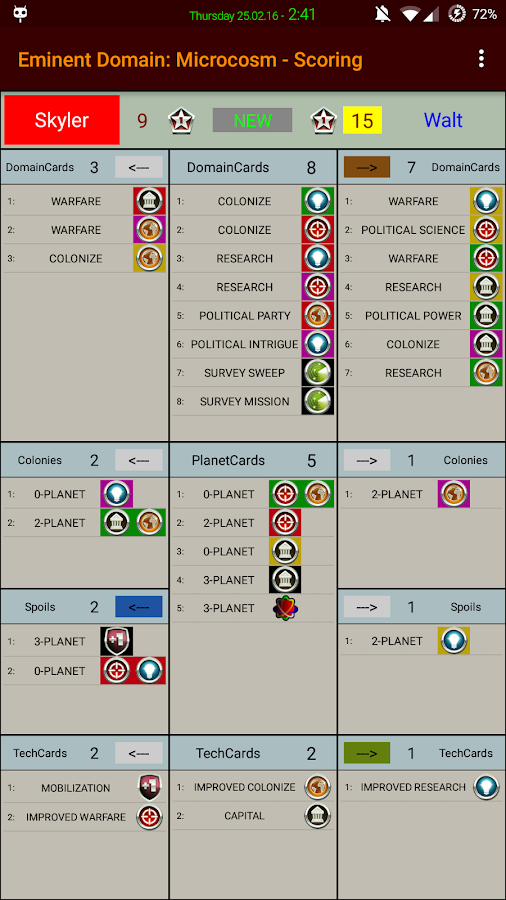
Eminent Domain: Microcosm -- fan made scoring app (Android)

Microcosm Scoring App

BGG user Frank Roitzsch (shinkyo) contacted me through geekmail and asked for my blessing to share an Android based scoring app he'd made for Microcosm.

Of course, I was thrilled to see a fan creating accessories for a game I'd made, so I granted my blessing forthwith, and now that scoring app is available (just click this link)!


Here's what a screenshot looks like:


Please note: this is an app to help score the game, it does not aid in game play at all. And it's made for Android. I do not know if Frank has plans to create an iOS version or not. If people ask for that, I can see if he's able to do it, but I wouldn't hold my breath on that, he might not even know how (I know I don't)!

Many thanks to Frank Roitzschfor creating this. I look forward to installing it on my phone and giving it a try. Hopefully this app will give you a reason to break Microcosm back out and give it another go as well :)

How To Play

I know some people had trouble with the rules sheet, so here's an awesome instructional video starring Pep over at Watch It Played:


And what the heck, here's a Gameplay Runthrough and Final Thoughts from Richard Ham of Rahdo Runs Through as well:

Have fun storming the Galaxy!

Monday, February 22, 2016

Crusaders faction powers - some new, some tried and true. With commentary. And updates.

Since I'm bored at work waiting for 80,000 more files to download (freaking DropBox... like all technology, it's good while it works, and it's a pain in the butt when it doesn't), I figured I'd think a little bit about my games. Most recently I made some updates to Crusaders, modifying the board (2p, as well as 3-4p), and inventing 8 more faction powers to try out.

Yesterday I got a chance to play a 2p game, on the new version of the 2p board, and I took the opportunity to try 2 of the brand new, as-yet untested faction powers. I think that game went OK in general, but it'll take a lot more testing to check the balance of all these new faction powers...

Here's a current list of all the faction powers, both old (tested) and new (untested), with some of my thoughts on each:

After another playtest and some more thinking, I'm going to interject with red italic text. For production/art cost reasons I might want to stick to 10 Faction powers, in which case I'll be choosing the best/favorite 10 of the 18 I've currently got, so I'll mention here which ones might or might not make the final cut.

The Knights Teutonic
You may distribute Action cubes either clockwise or counterclockwise (as opposed to the usual clockwise).

This has proven to be a very popular faction power, especially among new players. I think it's a solid ability, and appropriately powerful. this kind of rondel control is what I originally had in mind when designing the game. This faction more than some of the others will interact strongly with the actual order of the Action bins on the rondel.

This is one of the original, staple abilities, and it will certainly make the final cut.


The Knights Hospitaller
Start with 11 Action cubes on your rondel. Once per turn when distributing Action cubes you may skip 1 Action bin.

I thought this would be a fun one, allowing a player to skip a bin in order to recharge another one faster, or to ignore a particular action altogether. Indeed, it's a useful ability, and proved to be strong enough that I nerfed it by removing a cube from the board. This faction has seen a lot of play, and I believe this version is appropriately powerful.

This is one of the original, staple abilities, and it will certainly make the final cut.


The Knights Templar
Start with 10 Action cubes on your rondel. Once per turn when distributing Action cubes you may place 2 cubes into the same Action bin.

Like the Hospitallers, I thought it would be fun to be able to recharge certain actions more quickly, to get people away from having to just use every action on their rondel about the same amount over the course of the game. I was correct, it is fun to do so, and this particular effect proved so strong I nerfed it by removing *2* cubes, and it still seems to hold its own.

This is one of the original, staple abilities, and it will certainly make the final cut.


The Order of Santiago
Begin with 1 rondel upgrade of your choice. When distributing cubes, you may begin with the original Action bin.

Originally this effect was "you can leave unused cubes behind" but for some reason that wasn't as clear, and really only worked if you "overpaid" for an action -- in other words, with normal "good play" you would avoid your ability altogether! So I changed it to allow you to start distributing in the original bin, which means you can recharge it faster. This didn't seem to be as strong as the other rondel control abilities, so I combined it with a rondel upgrade. This one isn't as fun as those first few, but I think it's fair and reasonable.

This one is nice because it has another way to control the rondel distribution, so at least 1 faction should have that. I'll have to figure out whether it should come with an extra cube, or a rondel upgrade, or what. I might cut the rest.


The Knights of St Lazarus
Begin the game with 2 rondel upgrades of your choice.

I thought it would be fun for a player to sort of choose their strategic path by allowing them a few upgrades. this only saves them 2 turns over the course of the game, but they get to use those upgraded bins immediately as well which is a big plus. I suspect most players will choose Travel/Build as at least one of their upgrades, as that's immediately useful, but I suppose its usefulness wears off fairly quickly if you're not pursuing a heavy building strategy.

So far this one seems to be the weakest of the original set of 10 factions. So much so that I'm considering upping it to 3 upgrades. At one point I considered simply upgrading the entire rondel, but a player suggested it would be more fun to sort of pick your upgrades to suit your strategy or play style (and I agree, though of course it'd be simpler and better to start with an entirely upgrade rondel).

Since this one seems so weak, it might not make the final cut. Or else I might give it 1 more upgrade and see if that feels any better.


The Knights of the Holy Sepulchre
-1 Travel. Begin the game with 14 Action cubes on your rondel -- place 1 additional Action cube into each Travel action bin.

Originally this faction simply started with 1 extra cube, and while that's obviously benefitial, it didn't FEEL like an ability. So I quickly made it 2 extra cubes which you could place into any 2 bins you want. Eventually I specified that the extra cubes go into the Travel bins, mostly because a new player could have a hard time deciding where to put them, but partly because this faction seemed to be a bit too strong. I played that way for quite some time, and while the Holy Sepulchre didn't win every game, it certainly seemed like the strongest faction. I wasn't sure if it was really too strong, or if it was just more straightforward. Having extra cubes on your rondel makes all of your actions a little stronger on the average, it doesn't require any further decisions to gain that benefit. On the other hand, a player with a trickier ability might not gain its full benefit due to poor play.

I have recently decided that this faction is likely too strong, so I added the "-1 Travel" drawback. Now the faction is on the average better at ll of the actions, except travel. I haven't tried it with this drawback, but I suspect it'll be OK.

This is something of a staple, so it will probably make the final cut unless it proves too strong (I haven't tried it with the -1 Travel nerf yet).


The Knights Calatrava
Start with 6 Action cubes on your rondel (1 in each Action bin). +1 Travel, +1 Muster, +1 Build, +1 Crusade, +1 Influence.

This faction is possibly my favorite. It's very tricky and hard to use well, but can be very powerful when used correctly. As such, I tend to not use it with new players, and I describe it as a sort of "advanced" faction, which shouldn't be used until you're familiar with the game.

That might be an indictment, I'm not sure I want to include a faction that could cause a bad first play (I highly suspect that many players would ignore any warning not to use it in their first game).

As my favorite, this one will probably make the final cut, though if it's truly difficult to play then maybe I ought to cut it.


The Order of Aviz
Begin with 13 Action cubes instead of 12 -- place 1 additional Action cube into the Action bin of your choice. When distributing Action cubes, you may begin with the original bin.

Similar to the Order of Santiago above, but with an extra cube instead of an upgraded rondel tile. I suspect an extra cube might be better than an upgrade, but maybe not by enough to matter.

See the Order of Santiago, above.


The Order of Alcantara
Begin with 1 rondel upgrade of your choice, and 13 Action cubes instead of 12 -- place 1 additional Action cube into the Action bin of your choice.

This faction rounded out the set of combinations of +1 cube, 1 rondel upgrade, and the "start distributing in original bin" ability. It does feel better than just 1 extra cube (of course), and so it's probably about right -- if a little boring.

This was originally a sort of filler, and now that I've invented more powers this one might not make the cut. It's somewhat boring after all.


The Knights ________ (could use more titles!)
+1 Travel. Begin with 1 additional Knight in play.

I came up with this one a while ago, and originally it just started with the extra Knight. It occurred to me that additional knights aren't that great without extra travel as well, so I added +1 Travel as well. Ever since I did that, I actually like this one quite a bit. Most players will find that they need to build at least 1 Castle in the early to mid game in order to be efficient enough with their actions. Once that happens, there's a strong desire to build a 2nd Castle as well to get the extra travel. Once you're 2 castles in, you're well on your way down that "tech tree" -- no matter what your chosen strategy.

This faction frees players up to sort of ignore castles and concentrate on other things if they want to.

I like this one a lot, so it will probably make the final cut.


The following factions are brand new and have not really been tested. They are less about rondel control than some of the original faction powers, and more about allowing ways to pursue particular strategies in interesting ways:


The Knights ________ (could use more titles!)
Begin with 1 rondel upgrade of your choice. You may treat the Influence action as if it were Build.


The Knights ________ (could use more titles!)
Begin with 1 rondel upgrade of your choice. You may treat the Influence action as if it were Crusade.


The Knights ________ (could use more titles!)
Begin with 1 rondel upgrade of your choice. You may treat the Build action as if it were Crusade.

These three factions are my response to requests from players to be able to build 2 buildings in 1 action, or crusade against 2 enemies in 1 action. I couldn't put a reason to it for a while, but I suspected that would be too powerful. I think I've figured out why... the game is largely about using your rondel efficiently -- ordering your actions so as to minimize waste cubes. Allowing players to build 2 buildings in 1 action means they need worry less about overfilling their build bin, which is counter to the sort of central puzzle of the rondel.

However, I thought that if it were really powerful, maybe it could be a faction ability. but to avoid rules questions, I addressed it by allowing the player to use one action as if it were another. Each of these three factions can do one of the following, respectively:

* Build+Build
* Muster+Crusade
* Crusade+Crusade

Because simply being able to substitute the actions like that might not be strong enough, I added a rondel upgrade, which means these players could utilize these fancy action combos right out of the gate, which I think could be pretty cool. In the 2p game I played yesterday, I had the Influence=>Crusade faction, and it was pretty fun. Hard to say about balance though.

After playing another game, I'm thinking these three could be combined into 1 Faction: "You may treat the Influence action as either Build or Crusade". I might try that next, and if it seems good then it might make the final cut.


The Knights ________ (could use more titles!)
Gain 1 Influence token for each unused Action cube.

This was suggested by a player. Basically, it makes up for bad logistics by paying a player 1vp per excess cube. This is similar to, but different from, just adding "/INFLUENCE" to each rondel tile -- in that case you could get a lot of bonuses from having built churches!

It could be that those bonuses would be OK, but it sounds like too much to me. If the current wording proves disappointing (because playing "well"' means dodging your ability), then I could try wording it the other way, or I could try adding a cube to the rondel or something.

I haven't tried this one yet, and it's hard to tell if it's good or bad, fun or not.


The Knights ________ (could use more titles!)
Choose one enemy (Prussians, Slavs, or Saracens) and mark it on this card with one of your Action cubes.
+1 Crusade against that enemy.
+1 of that Enemy toward end game bonus scoring.

This was originally going to be 3 different factions, one for each Enemy. However, I didn't want too many factions that promoted Crusade strategies, so I smooshed them together into a single card. That worked out, because I suspect the ability is pretty darn good, so losing a cube (using it to mark which enemy you "hate") is probably appropriate. Of course, that's just conjecture at the moment, I haven't played with this faction yet.

I tried this one, and it seemed interesting. More testing is needed to see if it's appropriately powerful, but I could see this making the cut.


The Knights ________ (could use more titles!)
You may Build where an opponent has built at a cost of +1 cube.

As I mentioned in the last paragraph, I was worried that too many factions were crusade-centric, and I wanted something to help a build-heavy strategy out. One of the issues with heavy building is that the building spaces dry up pretty quickly, and by the end of the game you need to do some relatively healthy crusades in order to open up a building space. To address this, I actually tweaked the board to add a couple of spaces without enemies in them toward the right end of the board.

This faction allows you to build where another player has built -- not yourself, that seemed too easy. This way you could follow a opponents' knights around and build where they built. I thought about requiring you to build the same building that the opponent had built, or requiring it to be different, but eventually decided that the flexibility to build whatever you want would be best.

However, I didn't want to simply say "this player can build with abandon!" so I added that building over another player's building costs an extra cube. I wonder if it shouldn't cost *2* extra cubes! This faction also raises the question of whether the bonus tiles apply to the 2nd building. Historically, I've removed the tiles once a building is built in order to reduce clutter. During yesterday's game my opponent had this faction, and we decided to leave the tiles in place (and allowed the printed discounts to apply as well, like in Paris). After the game though, we both thought the tiles should in fact be removed from the board. that way there's still something of a race to get to the juicy spaces. If they are removed, then +1 cube is probably enough of a cost for overbuilding. I suppose for the same reason, maybe the discounts printed on the board shouldn't count for the overbuilder either?

Need more testing, but I like promoting a Build strategy.


Side note: I've been thinking that maybe the bonus tiles aren't potent enough... I think the 1 cube discount is probably good enough, but +1vp isn't terribly exciting. After the last game I thought maybe I'd up all the +1vps to +2 (and the +2s to +3). However I just had a potentially better idea... maybe when you build in a hex, you TAKE the tile, and count it as 1vp at the end of the game! Maybe I'll try that next time I play.

Regarding this note, I tried it and I think it might be good. Need more testing.


The Knights ________ (could use more titles!)
Begin with 13 Action cubes instead of 12 -- place 1 additional Action cube into the Action bin of your choice.
Leave a region containing an Enemy for 1 Travel instead of the usual 2.

I'm not sure how useful this faction really is, but it allows you the freedom to rush to the right side of the board and get the juicy building spaces very quickly. As the easier travel seems somewhat limited and not necessarily powerful I threw in an extra cube.

This one might not make the cut, but who knows -- maybe it's fun.

Haven't tried it. I suspect it's not going to make the final cut.


The Knights ________ (could use more titles!)
When you begin a crusade action, you may swap an enemy token where your knight is with an enemy token from an adjacent region.

This one sounds interesting to me. It can allow you to pursue end game majority bonuses, particular Saracen buildings, and potentially even inter-player interaction by swapping an enemy out from under them. I'm not certain how strong that is, but it seems like it's probably worth a try.

This one sounds interesting, and I'd really like to give it a try.
 

And now I'm down to 66,000 files downloading, and it's 6:00 pm. Hopefully tomorrow I'll be able to finish my work!


Friday, February 19, 2016

I found a mini-review of Terra Prime, by BGG user Rachel Schnoor (tartujik) -- Thanks for playing!

 I came across this mini-review on BGG of my first published game, Terra Prime. It was buried in a geeklist by user Rachel Schnoor (tartujik). It warmed my heart a little bit to see such a positive review, even now... 7 years after the game came out:

This is also a pick-up-and-deliver space game, but it plays with more people than the last one I listed (up to 5 players), is longer, incorporates fighting as well, and has little cubes for goods (and sometimes you just want to play with little cubes). The goods are names brownian, greenium, bluim which gives you an idea of how seriously this game takes itself. The art is really fun too. You have to watch out for asteroids, fight aliens, explore new areas of space, set up mining colonies for the different resources, etc. To help you combat the hardships of space and to give you an extra edge - you can buy upgrades, but to do so you'd have to use cubes you can get victory points for, so it's a trade off. I guess this game hints at 4x type stuff, but really it feels more pick up and delivery to me - the rest of your options are there, but are less of a focus. For example - in order to fight aliens effectively you have to upgrade your ship, in order to upgrade your ship you have to pick up little cubes required to purchase upgrades, in order to pick up little cubes you got to lark around space a bit - you get the point. Most of the baddies are out in deeper space anyway, so you have the option to avoid (the super bad ones anyway) by avoiding deep space... on the other hand, you get extra victory points for exploring the most dangerous depths of the unknown. Anyway, this game is colorful and light-hearted, but don't let it's image fool you - it's got a lot of strategic options - AND is just a real good time. Fair warning though - there were many print run problems with this game so if you pick up a copy make sure to ask plenty of questions about the status of the components.

I'm glad people are still playing Terra Prime here and there. It'll be awesome to see those that enjoyed the game come out of the woodwork when the game gets rebooted as Eminent Domain Origins (probably next year)!

Thursday, February 18, 2016

Crusaders (maybe) final version - PnP for blind testing

3/7/16 EDIT: Updated PnP Files - some minor changes:
* Upped bonus for Level IV Bank to 4vp/"IV" Building
* Changed the end game bonus for enemy majorities to 5vp for 1st and 2vp for 2nd
* Made end game bonus scoring tokens to hand out for those
* In a 2p game you can still get 2nd place in those, but you have to have at least 1 token to qualify
* Updated a few of the Faction powers

Rules: https://dl.dropboxusercontent.com/u/4093/My%20Games/Crusaders/PnP%20Files/The%20Knights%20Templar%20-%20Rules%20v6.5_3-7-16.docx
Files: https://dl.dropboxusercontent.com/u/4093/My%20Games/Crusaders/PnP%20Files/Knights%20Templar%20v6_3-7-16.pdf
Board: https://dl.dropboxusercontent.com/u/4093/My%20Games/Crusaders/PnP%20Files/KnightsTemplarMap%20v9_3-7-16.pdf
Playtest feedback form: https://dl.dropboxusercontent.com/u/4093/My%20Games/Crusaders/PnP%20Files/Playtest%20feedback%20form.pdf

Previous post follows:

Today I spent some time updating my prototype for Crusaders: Thy Will Be Done, and now I've got Print and Play files ready for blind testing!

I also threw together 8 more faction powers (first draft) which could use some testing, I'm sure some will be cut, but maybe some are good and fun enough to include in the game.

So... who would like to do some blind testing? I will post links to the PnP files below, I only ask that if you do print and play with them, that you email me with feedback -- especially on the balance of the faction powers (which are too strong, which are too weak, which are no fun, which you like best).

Crusaders files: https://dl.dropboxusercontent.com/u/4093/My%20Games/Crusaders/PnP%20Files/Knights%20Templar%20v6%202-18-16.pdf
Page 1: Building and troop tokens for 4 players (21 tokens per player) -- you have to sort of tape together the bottom row, they wouldn't quite fit on the page.

Pages 2 and 3: Player boards in 4 player colors

Pages 4 and 5: Rondel tiles, front and back. Make sure the correct fronts and backs are lined up... MUSTER (INFLUENCE) should go with (MUSTER / INFLUENCE) for example.

Pages 6 and 7 (OPTIONAL): Backing for the player boards. You could skip these.

Pages 8 and 9: Faction cards which bestow a special power.

Page 10 (OPTIONAL): Faction card backs. You could skip these.

Crusaders Map Board: https://dl.dropboxusercontent.com/u/4093/My%20Games/Crusaders/PnP%20Files/KnightsTemplarMap%20v9%202-18-16.pdf
Page 1: 4-sectional board for 3-4 players (print each section on a separate letter sheet and tape together)
Page 2: 4-sectional board for 2 players. Could go on the back of the 3-4p board. If not playing with 2 player, could skip this.
Page 3: Enemy Strength Track and Saracen tiles

Crusaders rules: https://dl.dropboxusercontent.com/u/4093/My%20Games/Crusaders/PnP%20Files/The%20Knights%20Templar%20-%20Rules%20v6.4%202-18-16.docx

Monday, February 15, 2016

Skye Frontier: An Isle of Skye / King of Frontier mashup -- updated rules

 For those following along, here's an updated rule set:

Skye Frontier: An Isle of Skye/King of Frontier mashup

Setup:

* Give each player a player board with a 4x5 grid of spaces (the exterior of the grid has pre-printed landscape types).
* Give each player a Castle tile, which they will pace on any space on their board (landscapes must match, roads need not).
* Shuffle the tiles in the bag, then draw 4 into a face up display on the table.
* Place 15 coins per player into a supply pile and return the rest to the box.
* Place a supply of green, black, and blue cubes nearby.
* Randomly choose a starting player and give the Starting Player tile to that player.
* Draw 4 Scoring Conditions and display them for end game scoring.


You are ready to begin!

Each round, the start player will choose a role from the list below and each player in turn will resolve that role. For choosing the role, you'll get a privilege. Then the Start Player marker will pass to the left, and the new start player will choose a role.

Roles:

Explore
Either:
(a) Draw 2 tiles from the bag, place one into your storage, and place the other face up into the supply.
Or...
(b) Take 1 tile from the face up supply and place it into your storage.

Privilege: Repeat this action after all other players have gone.
Ideas to try: Allow the option to Build the tile just taken instead of taking a 2nd tile. Or always allow building the tile immediately upon taking it -- this was the original rule, but Explore seemed to be the most popular action by far. 

Produce
Choose a landscape region and add 1 cube from the supply onto each tile in that region. Fields get green cubes, Mountains get black cubes, and Water gets blue cubes.

Privilege: Produce in a 2nd region.

Note: When completing a region, immediately produce resources in that region.

Trade
Choose a landscape region.

For Fields and Mountain regions: Take 1 coin from the supply for each tile in that region that has cubes, and connects back to your castle via roads. Then discard 1 cube from each of those tiles.

For Water regions:  For each boat in that region, you may discard a cube from that region. Take 1 coin from the supply for each cube discarded that way

These coins will be worth 1 point each at the end of the game.

Privilege: Trade in a 2nd region.

Build 
Take a tile from your storage and place it onto your board, paying cube costs (see below).

When building results in completion of a region, immediately produce resources in that region (see Produce, above).

Note: When a tile is placed such that landscape edges do not match, neither of the non-matching regions will ever be considered "complete".

Privilege: Pay only for non-matching landscape edges -- ignore other costs.
Ideas to try: Allow a 2nd build as privilege (at full cost).


Costs of placing a tile on your board:
Pay 1 green cube for each Sheep, Yak, or Farm on the tile,
Pay 1 black cube for each Tower or Barrel on the tile,
Pay 1 blue cube for each Boat or Lighthouse on the tile,
Pay 1 cube of any color for each non-matching landscape edge,
Pay 1 cube of EACH color for each scroll on the tile.

Game End:

The game is over at the end of a turn in which any player fills their board with tiles, when the supply of coins is exhausted, or when the tile bag is empty. At that time, each player should calculate their score to see who wins. Points come from:
* 1 point per coin collected via trade
* points based on scrolls on your player board
* points based on the end game scoring conditions

Tuesday, February 09, 2016

Crusaders final tweaks - tested!

Last week I posted about some final tweaks I'd like to make to Crusaders. I updated my prototype and tonight I got a 3 player game in to test those tweaks.

They went well! I liked the size of the board, the number of open building spaces, and the feeling that we were running into each other by the end.

I also liked the random distribution of 26 out of the 30 enemy tokens. This game it turned out that 3 of the 4 enemies left out of the game were Saracens, which meant that several of the free buildings couldn't be had by more than 1 player, and I think that scarcity will be good for the feeling of interaction in the game.

I left the Crusade VP the way it was, but I continued to scale the enemy strength up rather than taper it off like the score... this did not really make any difference though because we didn't get to the point where it mattered.

I did a heavy building strategy, building to level 4 Castle and Church, and influencing for a fair amount. I only crusaded 3 times (one of each enemy type). Danielle did a lot more crusading (8 enemies total), so she got a lot more points from that, as well as 18 points in endgame bonus, but she didn't get any level 4 buildings down. I ended up winning by about 3 points over her.

Here are a few things I think I'd like to do a little differently:
* Score majority bonus for Saracens - I haven't been doing that since in theory the Saracens help you score the level 4 building bonuses, but maybe it'd be better to reward it. If nothing else it gets rid of an exception.

Edit: I have started doing this, and I think I like it.

* Score 2nd place in a 3p game - currently the 2nd place majority bonus says "4p-only", but I'm not sure why. I think I'll try awarding it in a 2 player game.

Edit: First off, I meant in a 3p game (at the end there). In a 2p game I could just award the 2nd place tiles (Gold West does that), or I could award both -- with the caveat that you need at least 1 to qualify for 2nd place. I guess the latter would be more consistent.

* Try building/crusading in 2 spaces at once - This is something several players have asked to do, and I've been afraid it would be too powerful. I should give it a try though... if it does turn out to be too powerful, maybe I could make that a player power -- no rondel control, but the ability to Build in 2 hexes at a time, or to Crusade against 2 enemies at a time, given you have enough cubes.

Edit: I tried this, and it's too powerful. I think I figured out by I don't like it... This game is about efficiently managing your rondel, and if you can use the overage to just build more, then you don't have incentive to efficiently manage your rondel as much. I don't like the way that out of undermines the main mechanism of the game.

I have made new faction powers and tried to incorporate this power into one of them. It allows you to use the Influence action (an oft overlooked action, unless you're perusing that strategy) as if it were Crusade or Build. it turns out this is a really good ability, so I may need to nerf it, but I do like how an upgraded rondel could allow you to Muster + Crusade in the same turn, or Build + Build.

* Maybe try final lap again - I have never been 100% satisfied with the end game just sort of happening. I don't like when it sneaks up on you. In EmDo I changed so once the end game trigger happens, you finish out the round and then play 1 final round (a "final lap"), like in Railroad Tycoon. Maybe the same thing would be good here. I tried it before and didn't love it, but maybe I should try it again.

Edit: I have not tried this, and I'm not likely to do so. I think the end game will do as-is -- even if it's not my favorite part of the game.

And as a side note, the player power that simply starts with 2 additional cubes on the rondel MIGHT be a little overpowered, but not by a lot. Maybe it needs some kind of drawback... maybe something like "when upgrading, you may not distribute any cubes" or something small like that. Or maybe "-1 Travel".

Edit: I have tried adding "-1 travel" to this faction, which means they're a little better at all actions on the average because they have 2 more cubes (like 16% better), but they're always at -1 to travel. I think this might be a good nerf, though at times it seems really harsh. I know my friend John doesn't like it at all, and I have definitely felt like it was rough to deal with the -1 travel as well. I wonder if there's a slightly less harsh nerf for it.

Tuesday, February 02, 2016

Idea for solitaire card game, made multiplayer by first drafting the cards you play solo with

To be frank, I don't care much for them, and I don't play them much. there have been a few I've found interesting or impressive - namely Friday, by Friedemann Friese, and Pocket Civ, by BGDF'er Scott Slomiany (for which I contributed a resource mechanism). But for the most part, they're just not my thing.

I worked on the solo variant for TMG's Harbour a bit, and I worked on development for Dungeon Roll as well, which is basically solitaire. Not being a fan or a player of solo games, I'm not sure if my work in those areas really went in the right direction or not.

I've never really been interested in making a 1-player only game, or working on solo modes for my multiplayer games. If a fan is interested in making a bot to play Eminent Domain against, or a solo variant that doesn't require a "dummy" player, then more power to them!

But for some reason I was thinking about solitaire game the other day. I was thinking about a deck of cards that you would shuffle and hold in one hand like Flip City, and like Flip City you would look at the information on the back of the top card and decide whether to play it or not. More specifically, you would decide HOW to play it.

Since it's apparently my thing, I decided to use planets, resources, and upgrades... though this time I sort of had Terra Prime in mind rather than Eminent Domain -- maybe because I've been thinking of Terra Prime's upcoming return as Eminent Domain Origins :)

So you would look at the top card of your deck and you would decide whether to play that card as an upgrade (to make use of the upgrade text), or load it as cargo onto your ship somehow to be delivered to another planet, or flip it over and place it planet-side up in your row or network of planets -- like exploring, only it would probably tell you what type of planet it is on the info side of the card.

The idea would be that you're building some kind of network, and then shipping cargo of some kind through that network. Originally I thought the network could grow like a lattice -- in many directions, making a sort of hex grid out of cards. But maybe a simpler version is that your network is simply a line of cards from left to right.

Rather than actually having a pawn that traverses the network, perhaps what you're doing is trying to set up a line that will score well, and what you score is the cards you've saved for cargo (rather than put into play). In a way this scoring lines in an array of cards is similar to Arboretum, which I played once, and was reminded of last night when I saw some folks playing it. In that respect maybe a lattice-style network would make more sense, and I could use a scoring system reminiscent to (but hopefully less byzantine than) Arboretum's.

I figure that the planets should have types that are important, rather than needing to take a delivery to a specific planet, thereby making things a bit more flexible. In addition, I figure some cards would have hostile aliens rather than planets, which you would fight in a way similar to Terra Prime. Rather than adding dice to the game however, I would simply put a die icon on each card with some value, so looking at the top card of the deck you'd see the current "roll" value, and if I wanted to generate a new value, I could instruct the player to cycle that card tot he bottom of the deck and reference the new roll value on the new top card. I tried to utilize this type of roll aspect in a different game I never got around to finishing, and I always liked the idea of it...


So as you play your cards, one at a time, you would choose whether to use them as upgrades, or cargo, or to build your network. Some cards may have a cost, which could be paid by removing the next card in your deck from the game - thus that card would never get played... so paying a lot of costs would reduce your potential score, as well as deny you access to those particular cards.

Maybe a simple way to score would be to do it all at the end (like Arboretum), so a player need not record timing or order of cards played. Maybe any cards remaining in your deck count as cargo, and each one scores based on how you've built your network.

I started off by saying that I'm not fond of solo games. If this idea turns out to work, and be a fun and relatively simple to play solo game, perhaps it could be made multiplayer simply by adding a drafting phase in front of the solo game play -- so 2-4 players draft cards from the entire stock into their personal, then run through their decks making their own decisions as to how to play their cards. Perhaps there's just 1 big draft and then players play out their cards until they're done, or perhaps it's an iterative thing, where cards not played are set aside than hen mixed in with the new cards obtained in the next draft phase.

It's an interesting idea, and I'll let you know if I put any more thought into it.

Crusaders final tweaks

I'm happy with the status of Crusaders: the rules are solid, the flow is great, and the game is fun. I've even come to terms with the game end trigger.

The final tweaks I've been wanting to make have to do with the game board. I currently have a 2-sided board, one side is smaller (fewer hexes), and the other is larger. The larger board feels somewhat solitaire-y, as there's a lot of space, so players aren't bumping heads as much - though there does seem to be a good number of Enemies (10 of each color), and players tend to get through most of them by the end of the game*. Players also tend to build about the right number of buildings by the end of the game.

(*so I don't forget, I need to tweak the Enemy Strength Tracks for Prussians and Slavs - I think they're too valuable at the high end.)

The smaller board was an attempt to force players into conflict sooner and more often by reducing the number of spaces available. I removed most of the empty spaces, and reduced the enemy spaces as well. While this succeeds in making the board a little more crowded, it brings along a few issues I'm not happy about:

* The lack of open building spaces means that a "build heavy" strategy needs to do a lot of crusading, just like a "crusade heavy" strategy does. This makes those two extremes not really different enough, all players need to concentrate on building up their crusade strength and fighting enemies, even if just to make space to build.
* Majority scoring for Prussians and Slavs is kinda lame when there are so few of each of those enemies in play each game.

I've been unhappy with the small board for those reasons, but I recently had an epiphany that might help me fix everything!

In case you're not familiar with the game, there are 3 types of enemies... Prussians, Slavs, and Saracens. The Prussians and the Slavs each have a majority bonus for defeating the most enemies of that type. The Saracens have no such bonus, but instead give you a free building (or troop) when you defeat them - so they help you get the Level IV building bonuses. Prussians and Slavs are generic, but there are 2 Saracen tiles for each type of building (and 2 for troops). When I created the smaller map and needed to reduce the number of enemies on the board, I removed 3 each of Prussians and Slavs because I wanted to maintain 2 Saracen for each free thing you can get - I thought this was important so that players could use the Saracens to pursue whichever strategy they wanted to.

However, perhaps that's not necessary. Perhaps it's actually MORE interesting if NOT all 10 Saracen tiles are available each game. Maybe players would have to adjust their strategy if for example there are no Saracens that will give them a free Church. Or if there's only 1 place to get a free Castle this game. That could make for more interaction in the game when players want to go after the same Saracen, and it could help with a previous "issue" I had where there wasn't enough incentive to go to particular locations on the board.

My first thought when I had this epiphany is that I could go back to using all 10 Prussians and all 10 Slavs, and reduce the number of Saracens used in a game instead. Like from the pool of 10 Saracens, you use 5 or 6 each game. But then I thought it might be even more interesting if I simply had 25 or 26 Enemy spaces, and used that many enemies at random (from a pool of 10 of each). That way, in some games Prussians may be in short supply, making that majority bonus more interesting.

I think what I need to do is try this out, but first I need to know how many total spaces to have on the board...

* 25 or 26 enemy spaces,
* 4 Starting spaces
* 1 Paris space
* ?? Empty building spaces

I need enough empty spaces to support players attempting a heavy building strategy, but not so many that the board feels too open.

And finally, once I get the correct number of spaces, I might shift the map over a bit so that the Crusades are being fought more in the Middle East than in Europe, which may be a bit more historically accurate.

Friday, January 22, 2016

Crusaders coming to life! Artist/Graphic Designer needed!

I'm happy to say that my Knights Templar themed game, Crusaders: Thy Will Be Done, will be moving forward toward production!

I am looking for an artist and graphic designer to head up the graphic look of this project. That is to say that I need either...

* A person who is both an artist and a graphic designer, or
* Two people, one of which is an artist and the other is a graphic designer, or
* A graphic designer who has a network of artist from which to draw

I am contacting some of the usual people TMG uses, but with all the projects in the works right now we could use more artists and graphic designers!

So if you follow me, are a fan of TMG (or of Seth Jaffee), and if you're a professional artist/graphic designer who does work on board games, and if you want to bid on this project, please contact me with your portfolio.

Thanks in advance, I'm excited to see this one move forward!

And if you're interested in last minute blind testing, let me know in the comments.

Thanks!

Tuesday, November 24, 2015

Skye Frontier - a mashup (also, a word about fake variability)

A year or so ago I was introduced to The King of Frontier, which is a sort of mashup of Carcassonne and Puerto Rico - a role selection game where the roles allow you to draw and place tiles on your player board, produce goods on those tiles, trade those goods for points, and build some higher valued tiles.

Carcassonne's not my favorite game, but I have no objection to tile laying, and I absolutely love role selection in general and Puerto Rico in particular. So King of Frontier sounded like an excellent game that was right up my alley.

Unfortunately, upon playing the game, it left me wanting. I was not impressed with the balance, and I generally thought it fell flat. I wondered if I couldn't do better with a role selection tile laying game, but I didn't think about that for very long - instead I just sort of lost interest.

Recently I've become enamored with a new game called Isle of Skye. When I heard the title (spoken), I assumed it was some kind of airship game, probably with a steampunk sort of theme. But as it turns out, Skye is the largest and most northerly major island in the Inner Hebrides of Scotland. Isle of Sky is a tile placement game where you build your little board by connecting square tiles like Carcassonne, which you obtain by a nifty sort of "I-split-you-choose" mechanism wherein you price your tiles, then opponents have a chance to buy them from you - but if they don't, then you buy them for the price you set. Medici works something like that as well.

Side discussion about Isle of Skye and "fake variability"

I've played Isle of Skye a handful of times now, and I enjoy it a lot. the tiles you get have landscape features which you need to connect appropriately, and they have various icons which interact with scoring conditions in various ways.

That's one of the attractive mechanisms - there are many tiles that depict scoring conditions, and you only use 4 of them each game:
In round 1 you score condition A,
In round 2 you score condition B,
In round 3 you score condition A & C,
In round 4 you score condition B & D,
In round 5 you score condition A, C, & D
In round 6 you score condition B, C, & D

So timing of scoring is interesting, and available scoring conditions changing game to game is interesting, it really gives a feel of variability and replayability... Or does it?

MOST of the tiles (there are one or two exceptions) score points based on different icons on your board, or your geographic situation (closed landscape regions for example). This serves to alter the values of the various tiles that you draw at random, which informs your decisions for how to price your tiles, and how much you should pay for tiles.

The thing is, it doesn't matter WHICH scoring conditions are up... you just reference them in order to make your valuation decisions. They could really be the same tiles every time and the game wouldn't really change - you draw the tiles at random after all! This idea of fake variability is interesting. It almost doesn't matter that the variability is fake, players will think it's real because it LOOKS like variability. I'm certain if the game came with static scoring conditions, people would complain that it feels too samey.

Now, if you saw the scoring conditions for the game, built a personal draw pool of tiles based on that, and always drew from that pool... then it might matter which scoring tiles were in and in what order they appeared, because you could include (or omit) certain tiles that will or won't score too well. for example, some of the tiles have end game scoring such as "1 point per Farm" which are independent of the variable scoring conditions, and you could include many farms and all of those score tiles when the scoring conditions don't include them, hoping players will allow you to buy them on the cheap as they chase the scoring conditions. THAT would be variability!

But I digress... let's get back to my original post, which is less about Isle of Skye, and more about fixing The King of Frontier.

Back on track

Where was I? Oh yes - I'd played King of Frontier and it fell flat, I wanted to take a stab at a better version but lost interest, and recently played Isle of Skye. Right...

The other day on a plane ride I was looking through my design notebook (as I am wont to do), I came across the notes about King of Frontier and I had an epiphany. Maybe I could fix the problems I had with King of Frontier by basically just playing with the tiles from Isle of Skye! I knew I had a copy of Isle of Skye waiting for me at home, so I wrote up some rules and looked forward to trying it:

Skye Frontier: An Isle of Skye/King of Frontier mashup

Setup:

* Give each player a player board with a 4x5 grid of spaces (the exterior of the grid has pre-printed landscape types).
* Give each player a Castle tile, which they will pace on any space on their board (landscapes must match, roads need not).
* Shuffle the tiles in the bag, then draw 4 into a face up display on the table.
* Place a certain number of coins (not sure how how many yet) per player into a supply pile and return the rest to the box.
* Place a supply of green, black, and blue cubes nearby.
* Randomly choose a starting player and give the Starting Player tile to that player.
* Draw 2 (?) Scoring Conditions and display them for end game scoring.
* EDIT: Make that *4* Scoring Conditions (after playing once, it was clear that more scoring conditions would be better)

You are ready to begin!

Each round, the start player will choose a role from the list below and each player in turn will resolve that role. For choosing the role, you'll get a privilege. Then the Start Player marker will pass to the left, and the new start player will choose a role... technically you don't need the Start Player marker, but since it's in the box, I used it anyway.

Roles:

Explore
Either:
(a) Draw 2 tiles from the bag, place one on your board or into your storage, and place the other face up into the supply. Placing tiles on your board costs cubes (see below). Or...
(b) Take 1 tile from the face up supply and place it on your board or into your storage.

Privilege: Repeat this action after all other players have gone.

Produce
Choose a landscape region and add 1 cube from the supply onto each tile in that region. If that region is complete, add 2 cubes instead. Fields get green cubes, Mountains get black cubes, and Water gets blue cubes.
EDIT: Now that I've played, I might try this instead: rather than double producing on a completed region, simply auto-produce once in a region when it becomes complete.

Privilege: Produce in a 2nd region.

Trade
Choose a landscape region. Take 1 coin from the supply for each tile in that region that has cubes, and connects back to your castle via roads. Then discard 1 cube from each tile scored that way. These coins will be worth 1 point each at the end of the game.

Privilege: Trade in a 2nd region.

Build 
Take a tile from your storage and place it onto your board, paying cube costs (see below).

Privilege: Build a 2nd tile.
EDIT: Instead of building a 2nd tile, I tried "get a discount of 1 cube" which seemed to work well.

Costs of placing a tile on your board:
Pay 1 green cube for each Sheep, Yak, or Farm on the tile,
Pay 1 black cube for each Tower or Barrel on the tile,
Pay 1 blue cube for each Boat or Lighthouse on the tile,
Pay 1 cube of any color for each non-matching landscape edge.

Game End:

The game is over at the end of a turn in which any player fills their board with tiles, when the supply of coins is exhausted, or when the tile bag is empty. At that time, each player should calculate their score to see who wins. Points come from:
* 1 point per coin collected via trade
* points based on scrolls on your player board
* points based on the end game scoring conditions