Monday, September 26, 2016

General update to The List

About a year ago I revisited The List to take stock of the status of my game projects. I thought it might be nice to update that list a little bit, as some of the games on it have made some progress...

Published Games:
Terra Prime (BGG)
Eminent Domain (BGG)
Eminent Domain: Escalation (BGG) (expansion)
Eminent Domain: Exotica (BGG) (expansion)
Eminent Domain: Microcosm (BGG)
- Isle of Trains (BGG)
Crusaders: Thy Will Be Done (BGG)
- Isle of Trains: All Aboard (expansion)


Finished But Unpublished Games:
Exhibit (BGG link)
Eminent Domain: the Dice Game
Dice Works (BGG link)
Wizard's Tower (BGG link)
Now Boarding
Suburban Sprawl

Current Active Designs:
Deities and Demigods
Eminent Domain: Oblivion (expansion)
The Pony Express
Odysseus: Winds of Fate (BGG)
Alter Ego (BGG link)

Old Standbys - games which have been around, 1/2 done and untouched, for years:
8/7 Central
Hot & Fresh
Dynasty
Kilauea
Reading Railroad
All For One (BGG)

Old Ideas that Haven't gone Anywhere (Yet) - some of these have been getting stale as well:
Rondel Role Selection
Investigative/Tabloid Journalism
Red Colony
Clash of the Kingpins
Time = Money
Dating Game
Ticket Please
Moctezuma's Revenge
Scourge of the High Seas

Let's take a closer look at some of these:
Published games:
Crusaders: Thy Will Be Done (BGG)
I'm excited to say that Crusaders is moving forward at TMG! Adam McIver, now a full time TMG employee, has been spending some of his time working on the art and graphic design of the game (I shared the box cover recently), and it looks fantastic!
Isle of Trains: All Aboard (expansion)
Dan Keltner and I finished our expansion to Isle of Trains for Dice Hate Me/Greater Than Games almost a year ago, and we've recently been told that it will finally be on Kickstarter in the next week or so! The final title of the expansion is Isle of Trains: All Aboard.
Terra Prime (BGG)
In the near future (perhaps for TMG's 10th anniversary) we will be bringing back Terra Prime as a 2nd edition, with updated rules, expansion included, and set in the Eminent Domain universe. It'll be called Eminent Domain: Origins.

Finished But Unpublished Games:
Exhibit (BGG link)
I'm disappointed in the current status of Exhibit. A European publisher was very interested, but a difference of opinion between me an another designer on "IP rights" sort of nixed that deal. I checked with an IP lawyer to ensure that my understanding was correct, which it was, but the whole thing has left a sour taste in my mouth.
Now Boarding
I worked on this with Tim Fowers (Wok Star, Paperback, Burgle Bros, and most recently Fugitive). Since we made this game he has taken it in a bit of a different direction, and I think he might be making that version of Now Boarding his next project.
Suburban Sprawl
Based on another DHMG/GTG contest - this time a dexterity game (which uses 57 cards, plus score sheets)- I designed Suburban Sprawl with Matthew Dunstan. In Suburban Sprawl you toss cards into play to build Residential, Commercial, Industrial, and Civic buildings. I was going for a light, quick game with a sort of SimCity feel that's easy to learn and play, and at that I think we succeeded. Unfortunately, we didn't win the contest :(
Current Active Designs:
Deities and Demigods
Another attempt at Deck Learning, Deities and Demigods is like a role selection game, but the game calls the roles, and in random order. Players will have some control over which roles are in the deck, and can upgrade their efficiency at each role. The effects of the roles will allow players to move armies around a map in an effort to complete quests and control cities. Matthew Dunstan has been working with me on this one, and it has taken shape quite well, dare I say it's nearing completion. I still would like to add some more interesting board elements (terrain, or at least water), and I have yet to try the "expansion module" featuring Hades, a deity that was cut from the base game.
Odysseus: Winds of Fate (BGG)
I keep circling and iterating on this one. I need to implement the mot recent change ideas and try it again.
Eminent Domain: Oblivion (expansion)
3rd expansion to Eminent Domain. I worked out how this would play several years ago, and once Exotica was in production I finally started prototyping and trying it. I've gone through an iteration or two so far, and I think I'm close to something I could call the final phases of development, but I've been concentrating on other games lately so this one hasn't been played in a while.
Alter Ego (BGG link)
Mike's always been a fan of this one. Alter Ego was finally shaping up, but it hasn't hit the table in a while now. I think with a little TMG Utah input and some nice art, this could potentially be ready for a GenCon 2017 release, but looking at the release schedule, that seems really ambitious (I don't think I can count on TMG development help on this one... too much going on over there).

Recent Designs That Are Not On The Front Burner:
Rondel Role Selection
Another variation on role selection, this one got off to an OK start, but hasn't gotten any attention in a while.

Old Standbys:
Hot & Fresh
I'm a little disappointed I never finished this one, but the most recent changes (several years ago now) seemed like a big step in the right direction. I'm just not sure how excited I am about a press your luck pickup/deliver game anymore.
Dynasty
This is my shelved design that I'm probably most interested in, or at least the one I think might have the most promise as a "mediocre euro."
Reading Railroad
I always think that Reading Railroad would be a fun word-building / connection game, but the truth is that people who like word games probably don't want to play a connection game, and people who like connection games probably don't want to play a word game. Still, I'd like to finish this one day.
All For One (BGG)
All For One might be my single biggest disappointment. It is the game that really got me into the design hobby, and I thought it was good - really good - but it never got any publisher interest. It's suffered some setbacks, and now, almost 10 years later, I feel like it might be a bit old fashioned and in need of an overhaul, but I don't have the impetus to overhaul it.

Old Ideas that Haven't gone Anywhere (Yet):
Investigative/Tabloid Journalism
I think a game where you put together parts of stories and embellish them to make them work would be a cute and fun game, but the theme may not really be very desirable, so I never revisited this idea, even though I think I had the main mechanism completely thought out.
Ticket Please
A game about controlling gates in airports and moving people to their destinations, in the same scope as a Ticket to Ride seems like it could be really successful, I'm not sure why I haven't revisited this yet.
Moctezuma's Revenge
Maybe it's because I don't really like press your luck games or deduction games much, but I never got back around to Moctezuma's Revenge, even though it sounds like a system that could make for a solid game.

Thursday, September 22, 2016

No fun blog post title, just a Board Games Insider interview, and some fancy art for Crusaders.

 A couple of weeks ago I recorded a quick interview with Ignacy Trzewik for Board Games Insider's new special interview episode series. That interview went live yesterday, so check it out and let me know what you think. (Is there an easy way to embed audio from someone else's web page here? Or is that like stealing or something?)

At the end of that interview I mentioned that I was giddy for another Seth Jaffee title (Crusaders) to be moving forward. Adam McIver has started on the art for it, and has been knocking it out of the park (as per usual).

 
I'll just leave this right here...

Yes, I used the word "giddy" (Michelle made fun of me for that), and it's true. I didn't realize how excited I would be to have another designer credit under my belt. I figured with Terra Prime (watch for the re-release as Eminent Domain Origins, coming soon!), Eminent Domain, Escalation, Exotica, Microcosm, and Isle of Trains (watch for Isle of Trains: All Aboard, coming to Kickstarter soon!), as well as all my developer credits (don't worry, I won't inundate you with those here), that the novelty would have worn off a bit.

But no. Maybe because it's been a while, or maybe because most of my design credits are for the same line of games... for whatever reason, I'm finding a feeling of excitement and yes, giddiness, at the thought of my next game coming out.

And it might help that I really like Crusaders. I think it's good. "Good" like I enjoy playing it over and over, but also "good" like I think it has a good chance of going over really well with players, leading to commercial success, and all the riches and popularity that accompanies being a "big name" game designer :)

Yeah, right. Someone on BGG the other day said they were buying Exotica and contributing toward my Lamborghini... I was like "Lamborghini? I am just hoping I can pay my bills this month!" :)

But wouldn't it be cool? Every time I have a game come out, there's a small part of me that thinks it would be so cool if that game somehow blew up, and really did lead to fame and fortune! Realistically though, the best I can hope for is that players do like the game, and that it sells enough to warrant reprints and becomes an evergreen title for TMG. Note that most games DON'T do that, many games don't get a reprint, and those that do may not get a 2nd reprint. If Crusaders warrants a reprint and an expansion, I'll count that as a success!

Thursday, September 01, 2016

Revisiting a classic post: Balancing Game Elements

I've been working on Harvest lately, an upcoming TMG title in the Harbour universe (side note: watch for Harbour on TableTop with Wil Wheaton, season 4!).

Here's the description of Harvest from BGG:

Mind the fields of Gullsbottom! Plant and fertilize your seeds, tend your crops, and utilize the various buildings at your disposal. You'll need to work smarter, not harder, as harvest season is coming to an end! Who will have the best harvest this year? Will it be you?
Each round in Harvest, you first draft turn order (and the benefits that come with it), then send your two workers into town and into the fields. Plant seeds, tend fields, and harvest crops to make room to plant some more! Utilize buildings and magical elixir to amass a bigger and better harvest than your neighbors at the end of five rounds of play.
Harvest is a worker placement game where you first reveal worker cards (spaces that will only be available this round), then draft turn order (the later you go in turn order, the bigger the bonus you receive), then place your workers and take the associated actions. In developing this game I've been working with the designer to figure out the appropriate power level of the actions in the game -- both the standard spaces on the town board, as well as the value of the worker cards, and the buildings you can build. As that's mostly accomplished, lately we've been working on the power level and balance of various characters you can play in the game.

At several points during this process I've been reminded of an article I wrote back in January 2014 called Balancing Game Elements... re-reading it now I think that might be the best game design article I've ever written. It continues to hold true today, as I have been using the same process to balance the elements of Harvest.

You see, a major benefit of working this way, finding an average value for an element (say, the buildings in Harvest) which incorporates all the costs and benefits of that element including opportunity costs, is that it leaves you with only one variable when designing things that interact with that element. This makes it relatively easy to determine things like the value of an action which gives you that element.

By way of example

Without knowing anything about the game it may be difficult to give you a concrete example, but I'll try:

In Harvest, there's a town board that has 3 main areas that offer a variety of different effects or resources. Each of these areas has a "Choose 2" space (letting you get any 2 of the things on offer in that area) which is limited to 1 worker, and a "Choose 1" space (letting you get just 1 thing) which is unlimited. In addition, each round you'll turn up a number of worker cards which have more action spaces on them. The value each of these spaces confers is defined as follows:

Choose 1 space: 1-2 units
Choose 2 space: 2-3 units
Worker card space: 3-5 units

So ideally you'd prefer to take a worker card space first, a Choose 2 space next, and a Choose 1 space only if you had no other option, just based on the value of stuff you would get.

However, the game is not quite that straightforward. A space that's technically worth 5 value might only be worth 3 to you because you can't use all of it's benefits at the moment. So there are plenty of times that a Choose 2 space is just as good if not better for you than a worker card space. Very seldom do I want a player to choose a Choose 1 (default, fallback) space over a worker card space though.

Note that these values are sort of average values, and they may depend on your situation and whether or not you can make full use of the resources you get from these actions.

That said, there are buildings in the game which can confer abilities, one-shot resources, or an end game scoring bonus. There is a wide variety of buildings, with 6 face up to choose from at a time, each supporting various strategies. It's difficult to evaluate exactly how much each of these buildings is worth, which is where my Balancing Game Elements post comes in handy. If you read that post, you know that step 2 in the process involves choosing a desired power level for the elements and designing the elements to be worth about that much. I'm currently choosing to assign a value the buildings in Harvest at "4". This means that I'm targeting an average value of 4, some buildings will be worth a little more or a little less, depending on whether you can utilize them to full effect or not.

One of the things you can get from the town board, an action that's always available, is building a building. So, if the buildings are worth 4, and the default "choose 1" space is supposed to be worth 1-2, and you can use that default space to build a building... then it follows that there should be a cost of 2 to use the build action on the town board. Also, if the worker card spaces are supposed to be worth 3-5, then perhaps one that just allows you to build a building for no cost is appropriate. Simple math, which can be applied because I wrapped all the variables into the valuation of the buildings.

Now, I may be incorrect in that evaluation. If I've over- or under-valued the buildings then that should show up in playtesting a players recognize and either ignore or capitalize on the imbalance. If that turns out to be the case, then I can easily re-evaluate them and adjust the actions that allow you to build accordingly. Let's say I significantly overestimated the value of buildings, and that they should really be worth only 2. In that case the standard build action on the town board should not cost anything, and a worker card that allows you to build should also come with 1-3 value worth of more stuff. Similarly, if I'd under-valued buildings and they are really worth an average of 6, then the standard build action should cost more, and the worker cards that allow you to build might also need some kind of cost.

An alternative to tweaking the actions is to make an editing pass at the buildings, either powering them up or down until they are more closely averaging the targeted value of 4, which would then justify the cost of the town board and the worker cards.

Hopefully that makes sense, and indicates the usefulness of incorporating all of the costs and benefits (including opportunity costs) into the value of the game element itself (in this case the buildings), rather than trying to think about things separately.

Friday, August 12, 2016

Deities & Demigods update

last time I listed some tweaks I'd made but hadn't necessarily tried yet. I'll revisit those here, and then explain the further tweaks I've made since the last post.

Let me begin by saying that I really feel like the game is working well and feeling solid. I'm happy with the progress thus far, and thinking back to the original versions, it definitely feels like a much improved game.

Here are the comments I made last time (in blue italics) as well as my comments on each:

* Buildings and artifacts no longer have set collection scoring.
I kinda liked the idea of set collection scoring on buildings and artifacts, like the Exploration cards have in Goa for example. However, it may have been a little out of control (or not), and more importantly, it was annoying to have to count up so many things at the end of the game. The more interesting rewards were the ones that gave you gold, favor tokens, devotion bumps, or advances on the Zeus track. So I just replaced all the set collection icons with those, and added another: 2 Troop movement.


This was a good idea, and last night I took it one step further... with the new icon-on-city-spaces thing (see below), I decided that buildings didn't need to have icons on them. They're strong action or end game scoring bonus is good enough, and you get the icon from the city (so long as you haven't built there before).

Also, removing the icon means I can revisit the balance of Building+Artifact vs Monument for level 4 Hephaestus, which was weighted too strongly in favor o B+A over M.

One player (the immutable T.C. Petty III) suggested that Artifacts were not attractive enough, and removing icons from buildings might help that situation as well.

* Building costs vs incentive to spread out and build in different cities.
Originally, each player was allowed only 1 building per city, so if you wanted to build another building, you had to move to another city before you could do that. There was some bonus for being the first player to build in each city, to give you some incentive to race to build in the cities before anyone else did.

More recently I've tried instead allowing multiple builds in a single city, with the rule being that you pay 1 gold per building already in the city... so if you stay put and build, it'll cost you more and more. Then the incentive to spread out is cheaper building. That was OK, but I wasn't sure I liked it.

My new tweak is this... each city now has 6 spaces for buildings. 5 of them each have one of the standard icons, the ones you find on the building and artifact cards:
- Advance x2 on the Zeus track
- 2 Troop movement
- 1 Gold
- 1 Favor token
- 1 Devotion bump

The 6th space has a better version of one of those:
- 3 Zeus track
- 3 Troop movement
- 2 Gold
- 2 Favor token
- 2 Devotion bump

The idea is that the FIRST time you build a building in a city, you may choose any remaining space to build in and collect the bonus. Any further building you build in that city is placed on top of your first building marker, and earns you no additional bonus. I had intended to also keep the cost of 1 gold for each building already built, but maybe with this tweak that's unnecessary... instead of paying more, you're giving up opportunity cost of getting those bonuses.

There's incentive to spread out so you can collect more bonuses, and there's incentive to act fast as the first player to build in each city has first dibs on the better-than-usual space.

One of those icons will be marked, and when players choose their starting city they will get the marked bonus (which will be the weaker version of whichever powered up bonus is in that town).


This seemed interesting, but I have since tried another version of the idea. Currently each city has a particular icon, and different spaces have a stronger version of it. For example, 3/2/1/1 Gold, 3/2/1/1 Favor, 3/2/1/1 different devotion track bumps... I made this change in hopes that (a) players may care more about which city they go to, and (b) there might be more of a race to build in cities because a 3 icon is much better than a 1 icon. I actually wonder if it should be 4/2/1/1, so that building first feels a lot stronger than building second.

* Virtual Zeus phase in cycle #1.
I was thinking that Zeus was kind of boring in the first cycle or two of the game, so in the last couple of games I have tried starting the game with a Zeus round before drawing any cards. This way Zeus would come up twice in cycle 1, but only once in cycle 2 (unless someone added a Zeus card). I've enjoyed this, but I don't know if it's necessary or not. Especially with the possibility of starting with extra Zeus track advances from your starting city this might not be important anymore.


Yeah, this was an interesting idea, but ultimately unnecessary. I got rid of it. I think more of the Initiative track advances make initiative fights interesting enough.

* Simplifying the board to a simple hex board.
I've always enjoyed the movement rules where you move on the vertices of the hexes rather than from hex to hex. But since I made the Quests and Cities reside inside hexes, that line has blurred. Some players get a little confused by the movement rules. It's possible the troops should just move from hex to hex and NOT reside on the hex nodes after all.

This dramatically reduces the size of the board, but if I similarly reduce the amount of troop movement you get from Ares then everything should still work similarly... so instead if 3/7/11/15 troop movement, you'll only get 1/3/5/8, and instead of costing 2 troop movement to bring a troop from your supply into play, it'll only cost 1. This simplifies Ares a bit, and the lower numbers might make movement turns easier and faster to execute.


This has turned out to be a fine change. One of those "kill your darlings" moments. I had initially imagined a grand, epic scale, and moving around the nodes makes the board much larger... but in effect this is the same thing, and it's much simpler to describe and perform the actions.

Some other issues that have arisen are mostly to do with game balance  and the values of certain things such as the favor of the deities (scoring for the cards in your display). I've iterated through several versions of those. The current version is as follows, which makes the deities basically worth 1-4vp. In a couple cases if you go extreme you can get a little more out of them, but if you do then you'll be sacrificing in other scoring areas, so that's probably OK:

Zeus: 2vp per other unique deity
  ...encouraging you to get multiple different deities. This might ought to be just "per unique deity"
Hermes: 1vp for each level of devotion (cube level)
  ...encouraging you to save up devotion to Hermes, because hoarding cash wasn't really working right.
Ares: 1vp for each devotion track with increased minimum
  ...encouraging you to not only get min bumps, but to spread them out. Indirectly this rewards questing, because that's where a lot of min bumps come from.
Hephaestus: 2vp for each city where you have 2+ building markers
  ...encouraging you to build, but without necessarily moving a lot.

Another main thing I did (haven't tried it yet) was to add a cost to increasing minimum devotion. Bumping up the minimums is strong -- and I want it to be. But a double bump is proving to be VERY strong, potentially too strong. I had a few ideas to combat this, and the simplest to try is adding a cost to it. Your 1st, 2nd, and 3rd min bump on any devotion track will cost you 1, 2, and 3 Favor tokens. This means you lose a few points for specializing in a deity and taking advantage of the power that entails, and furthermore it may not be trivial to GET the favor tokens, thus increasing the demand for things that provide them (some of the artifacts for example).

I added a Favor token to the Monuments, mostly to make them compare better to Building + Artifact, but as a happy accident it means if you build a monument, you'll have a favor token to spend on the min devotion bump.

This might be awkward, and lead to things like a player doing a quest and not getting the min bump reward because he doesn't have enough tokens, but maybe that's OK. And if this cost turns out to be too high, I could try 0/1/2 tokens instead.

Other potential schemes to combat this dynamic (in case the cost doesn't pan out):
* Only allow 1 min bump per track total (I don't like this because there are plenty of min bumps to go around, and I feel like everyone will just "specialize" in everything)
* Increase the length of the tracks (to 5, probably). this might mean also changing the cost for showing devotion to 0/1/3/6 for 1/2/3/4 bumps, which could be OK, but I might miss the tension of being broke and therefore having to resolve a deity prematurely because you managed gold poorly. Maybe that's OK though, you'd still have the "increase devotion or cash it in" decision, which is the meat of the game.

The other main thing I've been concerned about is duration. Currently the game feels fine when it lasts 4 or 5 cycles, but if it goes on to 6 cycles, I feel like it's dragging and overstaying its welcome. So I need some way to ensure it ends after 5 cycles, but arbitrarily doing so is lame. I'm going to try ending after 5 cycles at most, and the game could end early if the triggers occur, and I've got some ideas to spice that up a bit perhaps, which involve re-introducing Hera as a sort of game timer.

Related, I'd like to see control of cities play a bigger role in the midgame, which could come into play via this Hera scheme. I've got a few ideas of how to implement her rolling around, and I'll let you know which I decide sounds best, or which I end up trying out.

That's about it for now. Looking forward to trying the game again!

Friday, July 15, 2016

Quick AMA on Reddit! Yokohama Deluxe and other stuff...

I'll be on Reddit for an AMA between now and 11:00am MST.

Yokohama is blowing up on Kickstarter, but it ends tonight! If you've got questions about that game or anything else, come ask them on Reddit!

Old news... a comment on Reddit about Eminent Domain (and a little Under The Hood about EmDo)

  About a year ago Eminent Domain was featured on Reddit as "game of the week", and I answered a bunch of questions there.

  I don't spend a lot of time on Reddit, but I logged in just now to set up an AMA about Yokohama (TODAY, 7/15, at 10am Mountain time!) and I noticed a reply in one of those threads that I never saw.

  That thread has been archived, and I don't think I can reply anymore, but it was a good question and I feel bad for not responding. Also, the person asking the question (Alex Churchill) is a friend and fellow game designer, with whom I worked developing Steam Works for TMG. Alex reads this blog sometimes, so I wanted to take a moment and respond to his old comment.


  In reference to my saying that Colonize and Warfare are early game actions in Eminent Domain, and that the point of the game is to hustle into the mid-game, Alex replied:

How can Survey and Colonize/Warfare be the early game? Getting points from planets is more effective than getting points from Produce/Trade 90% of the time, so people are doing it right up until the final round. I'm guessing the "mid/late" game you refer to must be Produce/Trade? But by the time you've got more than 1 or 2 symbols, your deck is full of Colonize/Warfare/Survey cards, diluting the Produce/Trade, which makes it much more natural to continue to focus on points for planets rather than try to switch focus and lose out on the follows.
  Alex has a point, if you invest (and especially if you over-invest) in Colonize or Warfare int he early game, then it looks like changing to a Produce/Trade or Research path mid-game would be inefficient, and so there's a temptation to just continue flipping planets. Indeed, this could be your strategy, and if you do a good enough job with it you might pull out a win. I'll note however that "doing a good enough job" against good players will likely involve targeting specific technologies to support your strategy (things like Survey Team, Fertile Ground, War Path, Improved Warfare...), as well as good timing of plays and correctly reading and reacting to your opponents' roles (as well it should).

  Therein lies the rub. That point of view is kind of a "n00b" outlook, and even if it sounds counter-intuitive, you can do better by minimizing the number of times you call Colonize or Warfare, making good use of following your opponents, and setting up a research or trade engine as quickly as possible. Level 1 technologies help you do this, as they have 2 different role symbols on them, which helps combat the dilution effect Alex mentioned. Using research to keep your deck slim is also a potential strategy there.

  The thing to note is that once you get 3 or 4 resource slots in play, a Produce/Trade cycle is actually more efficient than a Survey/Colonize/Settle or Survey Warfare/Attack cycle. Once you get a trade engine going, the longer the game goes on the more you'll outpace planet flippers. Mix in a well timed Genetic Engineering, Specialization, or Diverse Markets, and you can really pick up those Influence tokens in a hurry, possibly curtailing the game before your opponents get a chance to make their big endgame play (researching a level 3 tech, or flipping that last planet).

  Eminent Domain is not just a Role Selection game with Deck Building in it, it's a Deck Management game as well. The whole point is to find a way to make your deck perform better :)

  I hope that answers Alex's question, and I hope some players still find this kind of thing useful. It warms my heart to think that people are still playing Eminent Domain!

Wednesday, July 13, 2016

Big life changes! New house, and games for sale.

I've got a lot of big life changes coming up, the most immediate of which is that I'm buying a house. It's a nice, big house with a dedicated game room, across town from my current house. I'm pretty excited about the new house, especially the game room, for which I went in on one of those Duchess gaming tables :)

I'll talk more about my big changes later, but in packing up to move to this new house, I decided to catalog my games and maybe sell some of them. I didn't do it in the most efficient or effective manner, but long story short, if you're local and want to buy some of my games, take a look at this list:

Seth's Giant List of Games, Some Of Which Are For Sale At Good Prices

I intended this to make moving easier, so I don't want to be making trips to the post office or finding boxes to ship things in, and I don't want to be selling things and waiting until some future time to actually hand them off. Ideally we can make the transactions at the RinCon fundraiser game day this weekend.

Email sedjtroll at gmail with "Games For Sale" in the subject line if you're interested in anything, are local, and can make the exchange with in the next week.

Thursday, June 30, 2016

Deities & Demigods: It's been a while... I've made some tweaks but haven't tested them yet.

The last time I posted about Deities & Demigods I mentioned that Hades didn't make the cut... at least not for the base game. I intend to keep him round as an expansion module (maybe on of those so-called "in-spansions").

After that post I did excise Hades, and I've played a few games without him... and I'm happy to report that it works just fine. Great! Now the game is easier to teach and learn, and is still interesting to play.

I have created all the stuff needed to try out the Hades module, but I have yet to try it out. As I was updating my prototype I made some other changes that I've also yet to try out, but I think will be pretty good...

* Buildings and artifacts no longer have set collection scoring.
I kinda liked the idea of set collection scoring on buildings and artifacts, like the Exploration cards have in Goa for example. However, it may have been a little out of control (or not), and more importantly, it was annoying to have to count up so many things at the end of the game. The more interesting rewards were the ones that gave you gold, favor tokens, devotion bumps, or advances on the Zeus track. So I just replaced all the set collection icons with those, and added another: 2 Troop movement.

* Building costs vs incentive to spread out and build in different cities.
Originally, each player was allowed only 1 building per city, so if you wanted to build another building, you had to move to another city before you could do that. There was some bonus for being the first player to build in each city, to give you some incentive to race to build in the cities before anyone else did.

More recently I've tried instead allowing multiple builds in a single city, with the rule being that you pay 1 gold per building already in the city... so if you stay put and build, it'll cost you more and more. Then the incentive to spread out is cheaper building. That was OK, but I wasn't sure I liked it.

My new tweak is this... each city now has 6 spaces for buildings. 5 of them each have one of the standard icons, the ones you find on the building and artifact cards:
- Advance x2 on the Zeus track
- 2 Troop movement
- 1 Gold
- 1 Favor token
- 1 Devotion bump

The 6th space has a better version of one of those:
- 3 Zeus track
- 3 Troop movement
- 2 Gold
- 2 Favor token
- 2 Devotion bump

The idea is that the FIRST time you build a building in a city, you may choose any remaining space to build in and collect the bonus. Any further building you build in that city is placed on top of your first building marker, and earns you no additional bonus. I had intended to also keep the cost of 1 gold for each building already built, but maybe with this tweak that's unnecessary... instead of paying more, you're giving up opportunity cost of getting those bonuses.

There's incentive to spread out so you can collect more bonuses, and there's incentive to act fast as the first player to build in each city has first dibs on the better-than-usual space.

One of those icons will be marked, and when players choose their starting city they will get the marked bonus (which will be the weaker version of whichever powered up bonus is in that town).

* Virtual Zeus phase in cycle #1.
I was thinking that Zeus was kind of boring in the first cycle or two of the game, so in the last couple of games I have tried starting the game with a Zeus round before drawing any cards. This way Zeus would come up twice in cycle 1, but only once in cycle 2 (unless someone added a Zeus card). I've enjoyed this, but I don't know if it's necessary or not. Especially with the possibility of starting with extra Zeus track advances from your starting city this might not be important anymore.

* Simplifying the board to a simple hex board.
I've always enjoyed the movement rules where you move on the vertices of the hexes rather than from hex to hex. But since I made the Quests and Cities reside inside hexes, that line has blurred. Some players get a little confused by the movement rules. It's possible the troops should just move from hex to hex and NOT reside on the hex nodes after all.

This dramatically reduces the size of the board, but if I similarly reduce the amount of troop movement you get from Ares then everything should still work similarly... so instead if 3/7/11/15 troop movement, you'll only get 1/3/5/8, and instead of costing 2 troop movement to bring a troop from your supply into play, it'll only cost 1. This simplifies Ares a bit, and the lower numbers might make movement turns easier and faster to execute.

I hope to get a chance to try these changes, as well as perhaps adding the Hades module back in with experienced players!

Wednesday, June 29, 2016

Shameless promotion - a couple of non-TMG kickstarters (plus Yokohama Deluxe!)

I'm not big into promoting other people's kickstarters, and as such I don't ask people to promote the projects I'm involved in either.

But tonight I played a game that a couple of local guys have up for crowdfunding right now called Martial Art. The project is funded, so this isn't a plea to help them reach their goal. It's a pretty fun little game of double-think. A 54 card deck supports 2 players for $12, and apparently you can play with up to 4 if you have 2 copies. I didn't play with more than 2, and I suspect I'd prefer 2 players anyway. However I also suspect that with 2 decks you could play a variant where each player has their own deck, which could cut down on any luck of the draw (or perceived luck of the draw) if you like.

I usually don't love the "let's both play a card at the same time" type of games, but this one was kinda fun. If you like that sort of thing then maybe give this one a shot.

Speaking of kickstarter projects, another local guy who made 3D models of the genetic component pieces for the upcoming TMG game Chimera Station is running a project for some software to help design 3D models for things like D&D characters. The software is called Desktop Hero, and you can follow the link to see what that's all about. I don't know much about the project or the software, but Andrew was a really nice guy and did a great job on our Chimera Station pieces.

So if you are in the mood to do some shopping on Kickstarter (perhaps you're backing Yokohama Deluxe from TMG...), maybe give those projects a look and see if they interest you at all.

And for those interested in Yokohama Deluxe, I'm going to be involved in fixing up the graphic design for the English edition, which is something that's definitely needed - the game is great, but the graphics make it a lot less accessible than it could be. So if you trust me, then you can be sure the game will look awesome (and I've played a handful of times, the game really is a lot of fun!)

Monday, June 13, 2016

R.I.P. Hades?

For a while now there was some question as to whether Hades has been pulling his weight. It's been a bit of a struggle to keep him relevant. Initially I was OK with Hades being a sort of support deity, enabling players to pursue building, quests, and city control. However, as Matthew Dunstan pointed out, you could pursue scoring from each of the other deities, but not Hades:

Zeus: Collect deity cards for end game scoring.

Hermes: Collect gold to spend on favor when showing devotion to deities.

Ares: Score points for controlling cities (Matthew would like to see even more in the way of scoring for Ares)

Hephaestus: Score points for buildings (I am strongly considering ditching the set collection scoring and going with something simpler, but still worth points in some way)

Hades does not provide any path to victory, and as a result, there's often no reason to add him to the deck. As yet he's served only as a way to get more troops into play, and then recycle them after doing quests or building. For me that was working, but it's become more and more apparent that it's not ideal.

I've got a couple of friends who tend to think that in a game like this, with 5 deities, a player should just be able to pick one, concentrate on it, and be competitive with another player who picked a different deity. I've never subscribed to that personally - I believe it's fine for games to have early game actions and late game actions, and I don't think it's too much to ask of a player to consider the benefit of the choices they make, and whether they make sense at this point in the game. For example, buying a big building early in a game of Puerto Rico is not the best choice, though I'll concede that they did make those too expensive for players to build right away.

But in the case of Deities & Demigods it does make sense that there be reasons to add any of the deities to the deck, so I was interested in Matthews suggestion to add a scoring avenue to Hades. He suggested adding Trial spaces to the Underworld that you could spend Hades points to occupy with troops, gaining some kind of end game bonus at the cost of permanently losing those troops. That scoring could even be interactive, like majority scoring for devoting the most troops to the trials for example.

While that does sound interesting to me, I can't help but wonder if it's really necessary. Maybe it's just too much... the explanation of this game tends to take longer than it should (EmDo is similar), so anything to reduce that would be welcome. So if Hades isn't really necessary, then it maybe better to just excise him from the game altogether like I did Poseidon.

So next game I'll try that -- no Hades at all, and no Underworld per se. Your troops will either be on your player board or in play. 2 Ares points will bring a new troop into play, and of course 1 Ares point will move troops around the board as normal.


But to stay true to theme, rather than just leave Hades on the cutting room floor, I think he could become a sort of expansion module. It actually seems like adding Hades as a module would be fairly simple...

* Devotion track for each player
* Underworld board (with Trial spaces)
* Hades starting Olympus card and a stack of 6 Hades cards
* Hades monument, talisman, and shrine (maybe other artifact/building cards that deal with Hades)
* Potentially a couple more troops per player
* Rules indicating how Trial scoring and Hades points work

If playing Hades-less works out, then I'd like to give this expansion module a shot. If it works, then maybe I can find a way to add other deities (such as Poseidon) back in as modules too!

Side note on controlling cities:
I've been struggling with city control scoring, and how it's sort of all-or-nothing. I'm beginning to think that perhaps you should only count troops, not buildings, for control of cities. Furthermore, I think the scoring should be 1 per city you have troops in, and an additional 2 or 3 if you have the MOST troops in that city. That way you can pursue some scoring by running your troops around the board, and you can score better if you make sure to outdo your opponents. I've been thinking of adding a couple of troops per player for this reason as well, so you can reasonably fight for a couple of cities.

Tuesday, May 24, 2016

Deities & Demigods -- quick update

I just tweeted about Deities & Demigods with a link to this blog tag, so it seems prudent to post a quick update on the latest few plays of Deities & Demigods.

The Deities

In short, I deleted Hera, Poseidon, and boats altogether so there are only 5 deities now:

Zeus: 
No longer a turn order track per se... turn order is clockwise from a start player, and the leader on the Zeus track at the end of the cycle becomes the new start player and choose a deity to resolve and add to the deck.

There are now triggered benefits every couple of steps along the Zeus track (devotion bump, God card for scoring, a Favor token, and a minimum Devotion bump), and everyone resets at the end of each cycle.

Hermes:
No change here, Hermes continues to deliver gold which you use to show your devotion to the deities.

Ares:
With the removal of boats, Ares is the deity in charge of moving your units (just "troops" now) around the board. I upped the values at each level, and I've been liking the recent update tot he board: 4 board pieces at all player counts, and you move around the hex nodes, and into the hexes at cities and quest locations.

Hephaestus:
Buildings, artifacts, and monuments haven't changed (still using a separate deck for buildings and artifacts), but the level 1 reward has changed. Instead of 1 favor token (1vp), you now get 1 gold per building you have in play (minimum 1). Having removed Hera, it's nice to have some additional income opportunities, and I like the idea of building just a couple of buildings in the early game and then ignoring Hephaestus and just taking 3 gold whenever he comes up (juxtaposed with concentrating on Hephaestus and scoring off a lot of buildings and artifacts).

Hades:
I like the existence of Hades, who brings troops back from the underworld. After removing combat from the game it was questionable whether this would be relevant though. I think I've found a way to keep Hades relevant...

Currently you start with just 2 troops in play, 4 more in your personal supply, and 4 more in the Underworld. Hades moves troops from the Underworld to your personal supply, or from your supply to play. So you can use Hades from the outset to get more troops into play. Whenever you build a building, one of your troops goes back to your supply, so Hades will help you get them back into play. When completing a quest, one of your troops goes to the UNDERWORLD, so you can either consider them lost forever, or you can show some devotion to Hades to get them back into circulation. Considering that you only have a total of 10 troops to work with, this could be a big deal.


The Demigods

Since I've changed the game so dramatically, my sample player powers kind of fell apart. I tweaked a fe of them, but rather than worry about that too much I made some standard player boards (same for all players). In the end I'd like to have A-side and B-side player boards like you see in Kings of Air and Steam for example, with more interesting, unique B-sides

Herekles:
Obviously Herekles should have some benefit when doing quests, or some small incentive to pursue a Quest strategy. I've been using "whenever you complete a quest, increase devotion to any deity by 1" which seems like a good reward. I might offer a few extra points for having done quests, but that might be too heavy handed.

Perseus:
Perseus had the ability to put units directly into play during Hades, but now that's the standard so I need to figure out something better for him. Perhaps allowing Hades to add troops to play wherever you have a troop (as opposed to wherever you have a building) for example. I'm not sure that would be good enough, but it might be interesting. I could also give a small benefit such as a gold whenever you take control of a city, or whenever another player takes control of a city away from you, to make city control more of a thing during play.

Nike:
Nike used to have a benefit on the turn order track. After the changes I think his ability has to change to something like "when resolving Zeus, move 1 extra space on the Zeus track". I'm not sure if that's good or bad though. In any case, I'd like Nike's ability to have something to do with the Zeus track.

Jason: 
As captain of the Argos, Jason's original ability had to do with Poseidon and boat movement. Of course after removing that whole section of the game, this ability will have to change! Currently the board is just an array of spaces, I have been ignoring any kind of terrain (such as water). However in the end I would like the board to have some more texture, and I would like to see water being a thing. Probably I will just say something like "water costs extra to move over", and then Jason's ability will counteract or lessen that movement penalty. Until that's added though, I think there just isn't an ability for this player board.

I'm open to suggestions as to other demigods to use, and types of abilities they might have!

The next thing I will try is to expand the starting Olympus deck to 2 of each deity, rather than just 1.

Thursday, May 12, 2016

London, Paris, Deities, Demigods, Stained Glass, and Rock & Roll

LONDON

I just returned from a 12 day trip to Europe. An old online friend, Sebastian Bleasdale, got married in London, and he was kind enough to send me an invite. I suspect he didn't think I would come, but I called his bluff! I had a really good time at his wedding, and though I didn't get too much time to catch up with the busy groom, I was able to get some quality time in with a number of UK designers that I rarely see such as Matthew Dunstan, Tony Boydell, Brett Gilbert, Ian Vincent, and even caught a glimpse of big names such as Reiner Knizia and Richard Breese!

A gathering with so many designers would be nothing without a little playtesting and prototypes. I was able to play upcoming TMG title Pioneer Days (something like an Oregon Trail themed board game) with one of the designers (Matthew Dunstan), as well as test a drafting game by Tony Boydell, play an excellent mancala-rondel game by Sebastian and Ian based on my Crusaders rondel mechanism, see an interesting deck building (ish) game by Matthew, and even get my latest Deities & Demigods to the table.

DEITIES & DEMIGODS

I had some good discussion about Deities & Demigods with Matthew, who has expressed interest in co-designing that one with me, and I decided on some BIG changes -- some of which have been hanging around waiting to be tried, and some new ideas that came u in those conversations. The big changes include cutting out Hera, Poseidon, and boats altogether, and attaching the the manipulation of the Olympus deck to the initiative track itself. The original initiative track was intended to be for turn order, and there was supposed to be incentive to care about turn order. We decided that it may be easier to just have clockwise turn order from a start player, and we could reassign start player at the end of each cycle based on the initiative track. The new version has a few rewards that you get as you advance up the initiative track, and then the markers reset for the next cycle. Without Poseidon, there are simply troops that navigate the board. When we get the game working better we can add texture by saying things like "moving over water costs extra" or something. These changes worked out pretty well, as you'll see if you read on...

PARIS

After the wedding, I headed to Paris where I saw a number of touristy things including Notre Dame, the exterior of the Louvre, Ferris Wheel, Arc de Triumph, Eiffel Tower, and even Euro Disney. I enjoyed each (well, the Eiffel Tower was disappointing), even Disneyland was more fun than I expected. But I enjoyed Notre Dame most of all. In fact, looking at the stained glass windows, I came up with a new game idea... and in the following days I have pieced together a new game design, ready to be prototyped and tested! The game is a simple set collection game about building attractive stained glass windows. Watch for a future blog post about that one.

ETOURVY

When I found out that Bruno Faidutti was having a gathering during the time I'd be in France, I was excited at the prospect of attending. Bruno was kind enough to invite me, so I took a quick trip by train and got to see people like Ignacy Trzewiczek, Bruno Faidutti, Bruno Cathala, as well as other French gamers and industry folk. At the event I got a chance to play Crusaders with some folks, as well as Deities & Demigods with all the new changes. The players were great sports as I stumbled through the playtest with brand new rules, and they said they enjoyed the game a lot. The changes worked out alright, but were a little wonky, so when I got home I made a few adjustments, and managed to get two 2-player tests in on Tuesday which went very well.

ROCK & ROLL

In Etourvy I also played a pirate themed press-your-luck dice game which someone thought TMG might be interested in, and then I pulled out my press-your-luck dice game, Rock & Roll. The latest version of Rock & Roll (with changes based on Game Design Attack #4) has players rolling dice to play songs and satisfy the crowd. I had been allowing players to lock in more than 1 die at a time where possible, but there was something unsatisfying about that... after this test comments implied that a better format might be to allow players to lock in only 1 die at a time. So every time you roll the dice, you first lock all Gaffes, then you must be able to lock the next die in the song or else you bust. Even if you have more matching dice, you can only lock 1 into the song, then you must either stop and score, or roll again.

This new format makes a lot more sense, and if the songs are designed such that they start fairly flexibly then they'll naturally get harder and harder as dice get locked. Players may press their lock going for more crowd tokens, completion bonuses, and making it harder for opponents to "outperform" the song. Or they can play it safe and stop early, risking that another player outperform their song and take the card away from them.

I suspect this is the correct format for the game. All that remains now is to tweak the cards to fit the new format, redesign the songs, and see if it's really any fun :)

Wednesday, April 27, 2016

What a difference a month makes... Deities & Demigods playtest, new version

A whole month ago at Game Design Attack #4 I had a test play of Deities & Demigods. I posted some notes after that play and updated my prototype, but never got the game back to the table... until tonight.

I've been very busy with Chimera Station, which will be on Kickstarter later this year, so I haven't been playing much in the way of other prototypes, but tonight I finally got back to D&D. For starters, I can officially say that lesson #1 is this: Don't let a month go by between playtests!

I rushed home from work to get my table cleaned up and get the game set up. I remember basically how the game is played, and I had a vague idea of the changes I'd made... but as it's been a whole month since I've even thought about the game, when my players showed up I found myself floundering and reading through my marked up rules to see what we were going to be doing. It might have been even worse because these players had played an older version of this game, so they sort of remembered how to play -- but half of what they remembered is out of date!

So the start was a little shaky, and I felt dumb not to be more prepared... but once we got going things worked alright... for the most part. I did have to audible a card that I'd forgotten to update, and a rule or two that didn't jive with the new changes. But at the very least we were able to successfully finish the game.

In my last post I outlined changes I'd made to the prototype, I'll go through those here and comment on how they went in play:

* Use only 4 boards (at all player counts).
I did use 4 boards, and it worked pretty well. I had a note that maybe 3 boards would be enough for a 2p game, but I guess I'll burn that bridge when I come to it.

* Put 2 cities and 1 quest on each city board (2 quests and 1 city on the back).
 This worked pretty well in conjunction with the previous point. This makes for 4-8 each of cities and quests. I made a note that as a rule during setup, make sure there are at least 5 of each... I think 4 would be too few.

* Rather than interacting with cities and quests from adjacent nodes, have players travel into cities or onto quest locations.
This was a little shaky because the board wasn't really designed with this in mind, but I think it worked. The players had some trouble with it, but I suspect most of their concerns could be alleviated with better graphics/presentation/explanation.

I think I'd intended for only troops to enter cities and only boats to enter the seabound quest locations, but in  practice that seemed weird (and our board setup had an isolated lake with a quest that no boat could get to), so I ruled that troops could get to the quests even in water hexes. And I'd drawn little rivers into the cities from the hex sides that were adjacent to water, so I rules that boats could enter cities, but only from where waterways were shown. After the game I drew similar land areas leading to the Quests on water hexes, but I wonder f that's going to screw things up.

* At the suggestion that a victory point for level 1 Hephaestus might be too much, I might try changing that to 1 gold (or, 1 gold per city controlled to help incentivize controlling cities in the early and mid game).
I tried "1 gold per city controlled", and maybe that happened once. I definitely would prefer "per city where you have a building" (or similar "per building you have built")... but I'm not really sure that's better than 1 VP. The designer that made the suggestion was very adamant that it need to change. He was comparing it to the level 1 abilities of the other deities, none of which score you points. But I'm not sure that's a fair comparison... I think the proper comparison would be Level 1 Hephaestus compared with higher level Hephaestus. But I will continue to try the "gold per city" thing, including the Home City which I will be instituting for the next game.
 
* I'm contemplating changing Hera's income to "1 gold + 1 gold per city controlled" to help incentivize controlling cities in the early and mid game.
I didn't try this, but did try it for Hephaestus level 1 (see above). I didn't like tying it to "control" of a city, might be better "per building".

I still might try upping the Hera income to "1 gold per building" as well (or instead), but that doesn't make much thematic sense, and I'm not sure if it should be both here and on Hephaestus level 1.

* I've had combat in the game from the outset because I figured it went with the theme, and I'd hoped it wouldn't be much different than area majority such as El Grande. However, I'm not a player who really likes direct confrontation in games, and I think this is not the type of game that would really go along with that kind of interaction. So I will try removing combat altogether, or at least make it expensive and rare like I did in Escalation.
I dropped the combat altogether and to be honest, nobody missed it. It had never really come up before anyway (maybe because the board was too big before).

Instead the rule is that you may pass through but not end movement on a node containing opposing units. Any number of units can co-exist in a city, and in fact control of a city is based on number of units there.

I had to change a couple of cards that dealt with combat. I changed them so they had to do with gaining or losing control of a city.

* I'm considering removing the deck of building cards, and instead allowing building tokens to count toward control of a city... it would be easy and intuitive to count control that way, just count up all of your wooden pieces in the hex. I'm not sure if I like that idea or not though, and I suppose if I didn't want buildings to count toward control, they could be punchboard tokens rather than wooden discs in the final game. It would reduce components and clutter to just cut the building deck though.
I liked the idea of cutting the building deck, but I'd want to reconfigure the bonus icons... to approximate this I just said A=D, B=E, and C=F... that part was fine, but changing the buildings like this was a big mistake.

You lose a unit to build (which I like, as it keeps Hades relevant), so making the building count toward control doesn't actually gain you anything. So without getting a building card, there's really not much incentive to build buildings over artifacts! In fact, I'm wondering if there ever really was such incentive... I think the Building Cards might be a little more powerful than the artifacts in some cases, but only in some cases, and only maybe (there ARE a number of building cards with end game bonus scoring opportunities).

If I'm going to remove the building cards, then buildings would have to be a whole lot better than they are now. But I think I want the building cards back. In addition to bringing them back, I might try counting the buildings as 2 units toward control, so they help you control a city AND they give you a powr and potentially set collection scoring. That will make them better than Artifacts for sure.

To parallel quests, maybe there should be a reward for the first player to build in a city... but what? I don't think a devotion or minimum devotion bump would make any sense. Maybe some gold? Maybe you get to place a 2nd building marker (counts as extra influence toward controlling the city)? Maybe you place the building token upside down, indicating that it's worth 3 influence instead of 2?

* If I cut the building deck, I'd have to adjust the scoring icons... instead of 4 each of 6 icons, I'd probably do 3 each of 4 icons. I could also consolidate the 12 best card effects I currently have between artifacts and buildings.
I didn't do this (see above). I would do it if I do end up ditching the building deck, but currently I think I'd like to keep it.

I suppose I could combine them into 1 deck, where a building gets you both the building marker and a card, and the artifact only gets you a card, but that might be tougher to swallow thematically.

* I keep going back and forth on the turn order track and what happens if you gain initiative and land on another player's marker. Currently you always go on the bottom of the stack, no matter which direction you were moving your counter. I might change that to top of stack if advancing and bottom of stack when losing initiative and see how that goes. I think I was trying to be consistent, and I liked always going to the bottom of the stack vs always going to the top, but maybe that consistency isn't necessary.
I did try it with top-of-stack if advancing and bottom-of-stack if descending, and I think I did like it better that way.

* I don't know if this will be necessary, but if I decide I need a fail-safe way to hard cap the game at 6 cycles, I could try this... take all the Hera cards out of the deck, and instead have a supply of 6 Hera cards. At the end of each cycle, add a Hera to the deck. When that stack of 6 runs out, that's the last cycle (6 total). The game end may trigger before that, but it would keep the max length to 6 cycles. This would make Hera come up less often in the first 2 cycles, and more often in cycles 4-6, which might actually be good to facilitate more opportunities to earn the favor of the god cards.
This is still a viable idea, but I don't know if I like it. I might try it some time. I'll note that I only really need 5 Hera cards for that, not 6... add 1 at the end of each cycle, and when there isn't one to add (after the 6th cycle), the game is over.

* With a smaller board it's possible that 4 cycles would no longer be too few, so I could even change the above idea to 5 Hera cards instead of 6 (for a maximum of 5 cycles).
Not sure about this (see above), but as I mentioned, this would only require 4 Hera cards, not 5.

Now that I have the game more fresh in my mind, and I've given those things a try, I am well armed to take the game with me to London tomorrow (er, today... in about 12 hours) and hopefully play it with some people while I'm there.

Monday, April 25, 2016

2, 3, 4, 5... That's the way we subitize!

 I learned a word a few years ago from a friend of mine -- a word that I don't use nearly enough. Not that it's a common word that would come up in conversation very often, it's actually a fairly obscure word that a lot of people probably haven't heard. But there's at least 1 context in which I think I will start to use it more often.

 And the word is (drum roll please)...


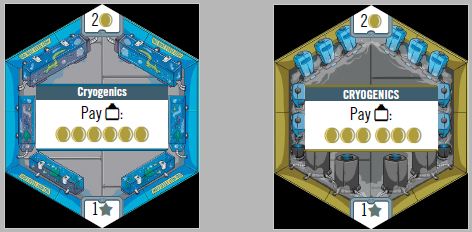
 The context in which I intend to use the word subitize more is iconography. I'm currently working on a game for TMG called Chimera Station, by League of Gamemakers member Mark Major. In Chimera Station, you employ a team of alien workers to build a space station, and in order to make your workers better at various jobs you splice brains, claws, leaves, and tentacles onto them. As you build the station you'll be adding numerous modules to the board, each one representing a new worker placement space:


 I've been working with graphic designer Daniel Solis, trying to express a lot of information onto these small tiles, with a little room for background art where possible. If you've played a game that has tiles like these then you probably know what I mean... there's a lot to convey, and a few different ways to try it:
  • Some games try to go language independent, replacing all English text with icons. This can lead to an overwhelming amount of hieroglyphics if the effects to be iconized are too complicated or varied.
  • Some games forego icons altogether and just use English text to convey all the information. The problem here is that text takes up a lot of space, especially if it's specific and thorough. Trying to abbreviate text to take up less space can be harder to read than the over-iconizing mentioned above!
  • Some games use a combination of text and in-line icons, which is what we decided to do for Chimera Station. On the down side it's not language independent... but on the up side, it offers the best chance at fitting the necessary info best and most clearly.

 It's that third option I'd like to talk about today. The first pass of the modules with in-line icons (see left images below) did manage to reduce the text, making the tiles more readable. However, the text is small, the space is compact, and most players will not even be reading it face up... so I asked Daniel to show multiple icons rather than a number followed by an icon ([coin][coin] rather than 2[coin]):

The parenthetical clarification was removed from the tile - it will be included in the rulebook. The right image shows a sample background, not the right one for this module.


 The new format looked great on tiles that only had 2 or three icons on them, but it introduced a different problem on modules with more icons on them. For example, Cryogenics allows you to trade a genetic component in for 6 coins...

Six coin icons is probably easier to read upside down from across the table. The cost (top) and VP value (bottom) on this tile got adjusted, but that's not relevant to this discussion.

 While I do think the version with 6 icons looks better than the original version, it's difficult to tell at a glance exactly how many coins you get. Which brings me to the whole point of this article... subitizing.

 The definition above indicates that humans are limited to being able to subitize about 7 items, but a more common or practical limit is more like 4 or 5 items. If you see fewer than 5 items, you can immediately know how many items there are without having to count them one by one. That's called Perceptional Subitizing.

 It could be that the 6 coin icons are too many for players to comfortably subitize, but I wasn't happy with the idea of going back to the original text version either. So I tried a simple tweak: I added a gap in the middle of the row of coin icons, separating the 6 items into two sets of 3 icons.

 Three items are easy enough for anyone to subitize, so breaking the coin icons up in to two sets will allow players to fairly easily combine 3+3 and identify 6 icons. This is called Conceptual Subitizing:

It's much easier to identify "6 coins" in the right image than the left one, isn't it? The tile also looks a lot better with the correct background :)

 There are only a couple of tiles in Chimera Station that have more than 5 icons on them, and for those I'm hopeful this format will work out.

 So, what do you think?

Were you familiar with "subitization", the concept if not the term?

In general, can we can count on people's ability to subitize in order to help create useful iconography in these games we play?

How have you used this concept in your games, even if you didn't know what it was called?

Tuesday, April 12, 2016

Should I include Emperor Avatars in Oblivion? Or make them a separate mini-expansion/promo?


A while ago I made something for Eminent Domain that I referred to as Emperor Avatars. These were tiles that players would draft during setup that confer some bonuses or abilities. They were intended to be an another Scenario sort of thing. I enjoyed them, and I think they worked pretty well, but I haven't done anything with them in a long time.

Now that I'm more actively working on Oblivion (PnP files are on BGG at the Tasty Tester's Guild!) I'm wondering if I should include them in that expansion -- possibly instead of Scenarios.

I recently added a host of Prestige planets and Prestige tech (for a while I wasn't going to include tech in Oblivion), and of course I already have Agendas and Clout tokens... Does the expansion really need more content? With the new tech existing it's likely I should make some Scenarios that use it, so maybe Emperor Avatars aren't necessary here.

On the other hand, I could make them into a promo item or mini expansion (or split them into a series of promos) and maybe give them away at conventions, use them as KS bonuses for Oblivion, include them in other games (perhaps Eminent Domain Origins?), or sell them for cheap.

What do you think makes the most sense here?

Saturday, April 09, 2016

Crusaders and Oblivion print and play opportunities on Tasty Testers Guild!

We have something which I think is an underutilized resource... it's the Tasty Testers Guild (number 1976) over at BoardGameGeek.

In the Tasty Testers Guild we sometimes post PnP files for upcoming TMG games when they're ready for blind testing. It has worked well in the past for games such as Exotica and Battlecruisers, but sometimes I put a game up there and get little if any response.

I currently have PnP files for two of my upcoming games (through TMG of course), and if you follow this blog you will recognize both:

Crusaders: Thy Will Be Done

Crusaders is fully blind-test ready, with a rules doc as well as up to date PDF files, and the game is very nearly in its final form. If anyone has a really great suggestion for the rules I'd consider it, but I'm mostly concerned with perfecting the game end trigger timing (number of influence in the supply at each player count) and balance of the faction powers. I probably won't include all 18 of them in the game -- I might cut it down to the best or most fun and interesting 10 or so.

If you play, please let me know what you think, where the game is fun and where it wasn't, which faction powers you liked best and least, and what you think of the game end trigger (was the game too long or too short, and if so by how much?).

---


And now that Exotica has arrived and interest in EmDo is stirring:

Eminent Domain: Oblivion

Oblivion has come a long way, through several distinct iterations over the last 4 years or so. I finally have the Agenda system where I think I want it, that part of the game seems to be working very well.

I have only recently added all the Prestige planets, the whole idea of Annexing planets, an all of the tech cards, so it's likely some of them are too good or not good enough, or that I'm trying to add too much to the game.

If you play this one, please first off tell me if the description in the Tasty Testers Guild thread made sense (sorry, I don't really have a rules doc for this one yet), and tell me what you think of the Politics role, the Agendas, the Annexing of planets, the effects on the Prestige planets, and the existence of (and usefulness of) the Prestige tech cards.

Now would be a perfect time to start getting some feedback on both of those games!

Thanks, and I look forward to seeing feedback in the Tasty Testers Guild!


Wednesday, April 06, 2016

Tips for playtesters

With UnPub 6 coming up this weekend, the State Of Games podcast this week was all about tips for playtesters. It's a good listen for people heading to UnPub or any designer convention, or otherwise participating in their designer friends' playtests.

To prepare for that podcast, Jessica putout a call for tips from designers to help players of prototypes contribute in the most helpful way when playtesting a game. I answered the call, and they summarized some of my comments on the show. I thought I'd share my advice here for anyone interested in reading the entirety of the email I sent them :)

"What are some specific tips you have for playtesters testing your games?"
I'm going to begin this answer as I often do, with the phrase "It depends."
The type of feedback you're after will depend on what stage your game is in, so as a designer it's probably a good idea to clearly communicate that to the players before you begin. Otherwise you'll end up with players interrupting the game to make suggestions about the graphic design of the player board that you just threw together to facilitate playtesting and will obviously be redone by a professional should the game ever see print!

TIP #1: Just play the game like it's a normal game.
In most cases when I'm playtesting a game I just want players to play it as if it were a finished game that came off the store shelf. Unless I specifically request it, I'm not looking for a player to go out of their way to break the game by doing things that aren't in pursuit of their own victory. Especially in early testing... finding game breaking loopholes and edge cases is my job as the designer, not your job as the player.

Now, if a you see a loophole that you can abuse in pursuit of victory, then by all means abuse it! But it's a waste of time to intentionally try to torpedo the game while doing something you're not realistically going to do in the game.
It's a bit different in a late-stage playtest when the game is nearly done. At that point it might be good to intentionally do something stupid to make sure the game holds up. I wrote a blog post on the League of Gamemakers about making sure a bad play or mistake won't keep a player from enjoying the game experience.

Tip #2: Avoid commenting on graphic design of a prototype.
Occasionally you'll playtest a game by someone who's self publishing, or a game that's got near final art, and in that case it might be acceptable to point out flaws in the graphic design. But in MOST cases when you're playtesting a game, it will have prototype components, lovingly hand crafted by the designer. That's secret code for "cobbled together in photoshop (if not MS Word), and printed in B&W -- and if you're lucky there'll be google image art here and there." This is NOT the final graphic design of the game, and the designer knows that.
Some game designers are also graphic artists, and their prototypes make the rest of us want to hide in a ditch, ashamed of the bland, boring look of our handmade games. But even those designers are unlikely using final graphic design and iconography.
My point is that interrupting the game to say "you know, this icon should really be a triangle" or "your green and red centimeter cubes you got in bulk from an education supply store aren't colorblind friendly" is probably more disruptive than it is useful.

I hereby apologize in advance for any difficulty you have learning and playing any designer's prototype that hasn't had the benefit of professional graphic design!


TIP #3: Don't interrupt play with suggestions mid-game.
When an idea or suggestion comes up, it's tempting to bring it up before you forget, while it's fresh in your mind. But that can be very disruptive to the playtest, so often times it's better to make a note of it and bring it up after the game.

TIP #4: Bring paper and pencil to a playtest session.
Speaking of note taking, it would be awesome if the designer handed out paper and pencil at the beginning of the playtest so that players could take notes of their thoughts during the game in order to revisit them later. Some designers do this, others (like me) would if they ever remembered to... but there's nothing stopping you from bringing your own paper and pencil to a playtest session!

TIP #5: Stay on topic during feedback sessions.
Often times feedback sessions aren't very structured, and that's fine. But if a designer asks a specific question, or asks about a specific part of the game, it's probably more helpful to address that question and only that question until the topic changes, rather than sidetrack the conversation with other unrelated thoughts (even if they're well thought out and good thoughts).

Tuesday, March 29, 2016

Treat the problem, not the symptom

Things go wrong in playtests all the time. When something goes wrong in a playtest, it may just be an anomaly of that particular game -- but if the same thing comes up in multiple plays, then it's probably indicative of some kind of problem with the design. As designers, it's our job to identify these problems and fix them.

This may be harder than it sounds though. Sometimes the issue experienced in a playtest is merely a symptom of a deeper problem. While it may be worthwhile to fix the symptom, what we really want to do is determine the underlying problem and fix that, or else another symptom is likely to rear its ugly head before long.


By way of example I'll illustrate what I mean:

When I was originally testing Eminent Domain, instead of the 5 different role cards in the game there were 6. Produce and Trade were separate cards, not combined into one card. Produce/Trade cycles had the potential to be more lucrative than other scoring paths, but the logistics behind having to take the two separate roles, and having cards for each in your deck, were supposed to balance that out. However, in practice I found that Produce/Trade strategies were frustrating to pursue because it was hard to score well off of the cycle. So hard in fact that players would ignore that strategy altogether.

At first I tried doubling the value of a Produce/Trade cycle, thinking that with higher rewards, players would pursue the strategy. In theory that worked, I could keep increasing the value of trading until it was worth going for. But that solution treated the symptom, not the problem. The more valuable I made trading, the more variable and swingy that strategy (and the game) would become... a player trying to produce and trade might never get their cards in the right order, and when they did they'd get a disproportionately high reward, like a slot machine. The real problem here was that it sucked to have to fill your deck with 2 different cards that were terrible on their own just so that MAYBE you can use them to collect lots of points.

Fortunately one of my players (thanks Wystan!) suggested putting both roles on the same card so that whenever you draw that card, it'd work for either the Produce role or the Trade role - whichever you need at the time. This solution ignored the symptom and went straight for the throat of the underlying problem. As soon as I tried it I immediately knew it was the right solution. And as a result of solving the problem, it eliminated the symptom as well.

So let that be a lesson to you. When something goes wrong in your playtests, don't take it at face value. Make sure to look and see if the issue is merely a symptom of a bigger problem, then do what you can to fix the underlying problem.